


 Brazil to Phase Out Gasoline Subsidy First as Diesel Support Stays Longer
  Oil Prices Steady as U.S.-Iran Talks Ease Supply Fears Ahead of Holiday Weekend
  South Korea Warns Won Is Undervalued, Boosts FX Coordination With Japan
  Oil Prices Steady as U.S.-Iran Peace Talks Ease Strait of Hormuz Supply Fears
  Japan Signals Readiness to Act on Yen as Intervention Speculation Grows
  US Jobs Report Preview: June Payroll Growth Seen Slowing as Fed Rate Decision Looms
  Gold Price Today: Bullion Heads for First Weekly Gain as Weak U.S. Jobs Data Eases Rate Hike Fears
  Alcohol is one of the most dangerous drugs, yet its presence is ubiquitous in social settings and celebrations
  USA at 250: the Black American struggle for life, liberty and the pursuit of happiness
  Mary Daly Says AI Uncertainty Clouds Fed Rate Outlook Despite Restrictive Policy
  Asian Currencies Rise as Dollar Weakens; Yen Holds Steady Amid Japan Intervention Watch
  Goldman Sachs Says China Competition Weighs More on EU Growth Than Trade Deficit
  JPMorgan Cuts Gold Price Forecast, Sees Bullion Reaching $4,500 by End of 2026
  US Resumes Dollar Shipments to Iraq After Months-Long Suspension


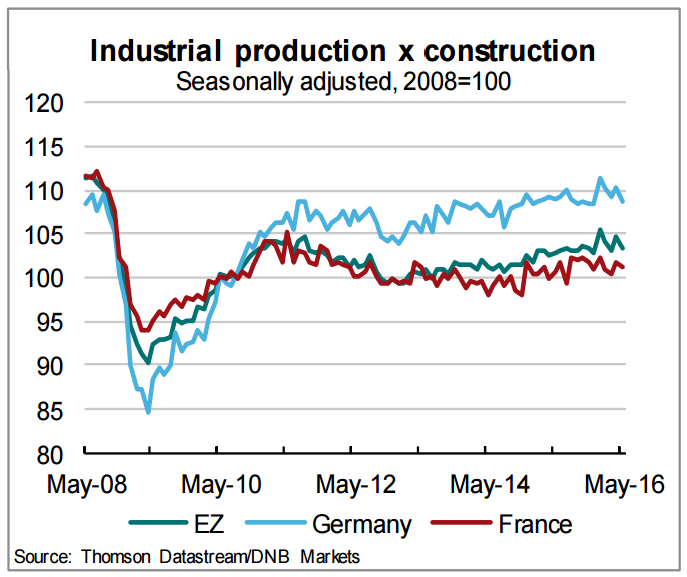
Data released by EU’s statistics agency Wednesday showed that eurozone industrial production fell by 1.2% m/m in May, compared to an upwardly revised 1.4% rise in the earlier month. Compared with May 2015, output was up just 0.5%. Industrial production has now fallen in five of the past seven months, with the three-month trend rate slipping to the weakest since August 2014. Production fell in Germany, France and Italy. The deterioration was broad-based, all main sectors recorded a decrease.
The sharp fall in May reversed almost all of the gains made in the previous month, in a fresh indication that the economic recovery, now in its fourth year, remains modest and vulnerable to new setbacks. Temporary factors like lower energy prices and weak euro have helped, but production has still been sideways. Outlook will be one of subdued growth.
“The potential contraction of the industrial sector in the second quarter, therefore, means the economy is likely to struggle to see anything like the ...expansion of GDP recorded in the opening three months of the year,” said Chris Williamson, chief economist at data firm Markit.
The indications for the second quarter are less encouraging. Data showed that growth was slowing even before the UK voted to leave the European Union on June 23rd. The more than expected drop adds to signs of a second quarter slowdown. The disappointing data follow survey evidence showing business optimism in the currency bloc sliding to the lowest since 2014 as political uncertainty intensified in June.
"After a solid increase in the first quarter of 2016, the industrial output is set for a clear slowdown in the second quarter, confirming our view that GDP growth will decelerate in spring after a strong performance," said Daniel Vernazza, UniCredit.
The euro was little changed following the release of eurozone industrial production data yesterday. On the day, EUR/USD is extending upside, trading at 1.1156 at around 1200 GMT. On the technical side, the pair has broken minor resistance 1.11260, jump till 1.1188/1.1225 is likely.







