


 NASA Artemis II: First Crewed Moon Mission Since Apollo Takes Four Astronauts on 10-Day Lunar Journey
  NASA's Artemis II Crew Arrives in Florida for Historic Moon Mission
  Reflection AI Eyes $25 Billion Valuation in Massive $2.5 Billion Funding Round
  OpenAI Executive Shake-Up Ahead of Anticipated 2026 IPO
  MATCH Act Targets ASML and Chinese Chipmakers in New U.S. Export Crackdown
  SK Hynix Eyes Up to $14 Billion U.S. IPO to Fund AI Chip Expansion
  Meta and Google just lost a landmark social media addiction case. A tech law expert explains the fallout
  Australia's Social Media Ban for Under-16s Sparks Global Movement
  China's Push to Steal Taiwan's Chip Technology and Talent Raises Security Alarms
  Annie Altman Amends Sexual Abuse Lawsuit Against OpenAI CEO Sam Altman
  Cybersecurity Stocks Tumble After Anthropic's Claude Mythos AI Leak Sparks Market Fears
  SMIC Allegedly Supplies Chipmaking Tools to Iran's Military, U.S. Officials Warn
  Apple Turns 50: From Garage Startup to AI Crossroads
  Chinese Universities with PLA Ties Found Purchasing Restricted U.S. AI Chips Through Super Micro Servers
  Microsoft's $10 Billion Japan Investment: AI Infrastructure and Data Sovereignty Push
  Britain Courts Anthropic Amid US Defense Department Dispute


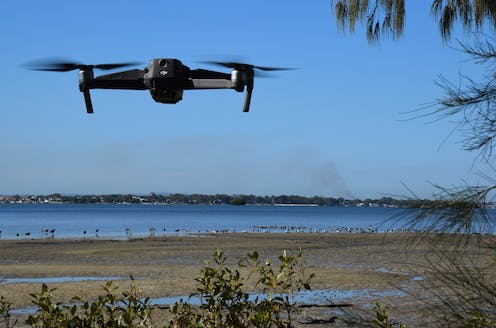

Drones are increasingly swarming our skies, capturing images, managing crops and soon, delivering packages. But what do the birds make of this invasion of their territory?
With strict animal ethics approval, we flew drones towards flocks of birds in Queensland’s Moreton Bay. We found many species were not disturbed, provided the drone was small and flew above 60m.
The exception was the critically endangered eastern curlew, which became alarmed and flew away – even when a tiny drone approached at the maximum legal altitude of 120m. But when the eastern curlew took flight, other nearby species were often startled, creating a domino effect that eventually caused the whole flock to take flight.
Drone disturbance can interrupt birds as they rest or feed. It can even cause them to avoid some locations altogether. If birds are consistently interrupted or scared away from their preferred habitats, they may find it difficult to eat and rest enough to survive and reproduce. This is particularly concerning for species such as the eastern curlew, which migrate thousands of kilometres to breed.
A drone’s view of a flock of royal spoonbill. Drone disturbance may contribute to population declines. Joshua Wilson.
Yet another threat to shorebirds
We studied a diverse group of birds typically found along coastlines, known as shorebirds. Heartbreakingly, their global population has plummeted as they continue to battle habitat destruction, sea level rise, disturbance and hunting.
The last few decades have been bleak for the eastern curlew, which is the world’s largest migratory shorebird. Research in 2011 indicated a population decline of 80% over three generations.

The eastern curlew is a critically endangered shorebird that is highly sensitive to drone-induced disturbance. JJ Harrison, Author provided
While drones are unlikely to have played a major role in shorebird decline so far, our results, combined with the increasing presence of drones along our coastline, indicate they could become yet another source of disturbance for these birds, many of which are already endangered.
Use with care
At the same time, drones have proven to be a valuable tool. They’ve been used to plant trees, deliver healthcare in developing countries, and have even proven useful for bird conservation.
Drones can observe birds in places that are hard to reach on foot, such as birds of prey nesting in tree tops, or seabirds feeding on tidal inlets. In some cases, they can even be more accurate compared to traditional ground-based survey methods.
Shorebirds spread out across vast mudflats to feed, making it very difficult to survey them on foot and identify critical foraging habitats. Our research has shown that, for certain species, drones may overcome this barrier, providing information that may be pivotal in arresting shorebird population declines.
Drones may be a valuable tool for surveying shorebirds as they spread out across vast mudflats to feed. Joshua Wilson.
Drones can be beneficial in many ways, but we must identify when and how drones can be used to minimise potential harm. In some locations, such as some Australian national parks, drone use is already prohibited or restricted. But managers need to understand how drones affect wildlife to inform these regulations.
Our findings provide clear-cut parameters around how much space to give birds to keep drone disturbance to a minimum. In most cases this is about 60m, but it can vary significantly between species. For the eastern curlew, we don’t recommend approaches within 250m, even with small drones.
The Moreton Bay Marine Park, where this research was undertaken, is the single most important site in Australia for the eastern curlew. Disturbing shorebirds within the marine park is an offence that can result in fines. The Queensland Parks and Wildlife Service has already used our findings to place conditions on research projects and media activities involving drones.
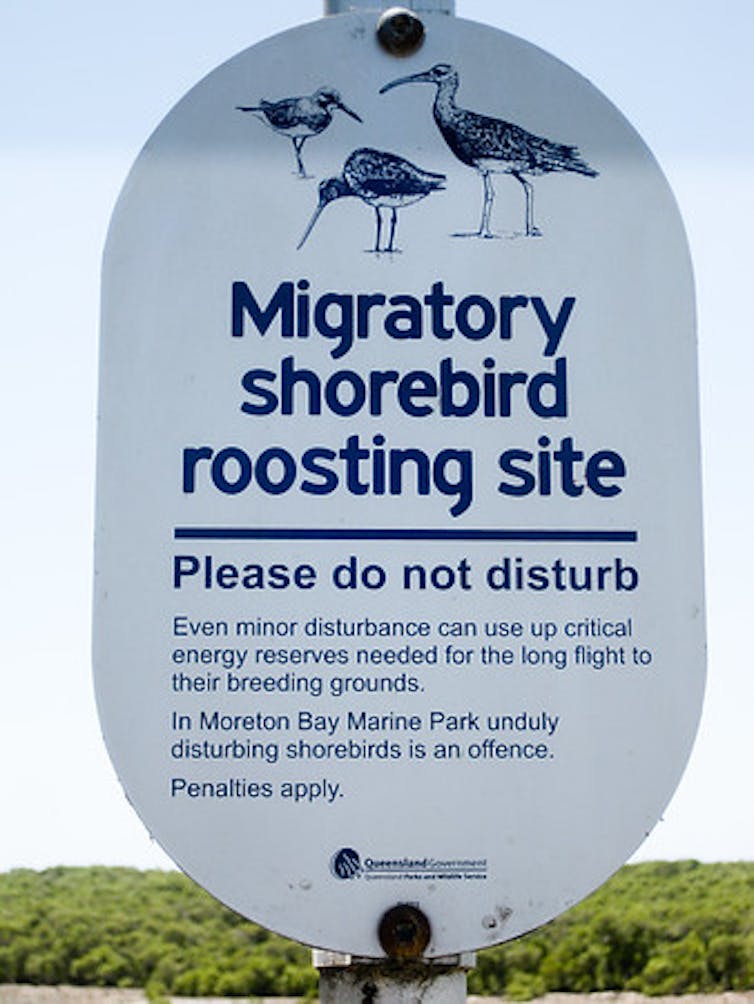
Within Queensland’s Moreton Bay Marine Park, it is an offence to disturb shorebirds. Des Thureson
Sharing the skies
We recommend organisations with influence on this issue, such as the Civil Aviation Safety Authority and national parks authorities, regulate drone use near bird flocks – especially those containing at-risk and highly sensitive species.
We also encourage those researchers considering adding drones to their conservation toolkit to carefully evaluate the risk of disturbance before using them to conduct wildlife surveys.
By understanding how shorebirds react to drones, we can inform effective and efficient management actions. Regulating drone use near critical shorebird habitats will help us to avoid exacerbating population declines, while still allowing the use of a valuable tool, where appropriate.
Hopefully, through small steps like this we can arrest the decline of shorebird populations, ensuring we can continue to share our shorelines with these beautiful birds for generations to come.
This research was supported by The Moreton Bay Foundation and the Queensland Wader Study Group. It was conducted under strict ethical clearance with the purpose of benefiting the birds with the knowledge gained.







