


 Goldman Sachs Raises USD/JPY Forecast, Sees Yen Weakness Persist Through 2027
  Asian Markets Slip as AI Earnings Season Looms, Oil Prices Fall Ahead of Key Fed Signals
  Wall Street Ends Mixed as Weak Jobs Data Lowers Fed Rate Hike Bets, Chip Stocks Tumble
  Gold Price Rises as Softer Dollar and Fed Rate Expectations Boost Bullion Demand
  New Zealand Consumer Confidence Rises in June as Inflation Expectations Ease
  Oil Prices Slip as Oversupply Concerns and U.S.-Iran Talks Shape Market Outlook
  Dollar Rebounds as Euro, Pound Slip Ahead of Fed Minutes, Yen Near Intervention Zone
  Oil Prices Steady as U.S.-Iran Talks Ease Supply Fears Ahead of Holiday Weekend
  Gold Price Today: Gold Slips as Dollar Rebounds Ahead of Fed Minutes
  China Services PMI Beats Forecasts as Strong Demand Supports June Growth
  Oil Prices Steady as U.S.-Iran Peace Talks Ease Strait of Hormuz Supply Fears
  Oil Prices Slip as OPEC+ Boosts August Output, Oversupply Concerns Weigh on Crude Market
  Goldman Sachs Flags 3 Key Risks Ahead of Europe’s Earnings Season
  Russia Stocks End Flat at Three-Year Low as MOEX Index Stalls, Gold Prices Climb
  U.S. Dollar Drops as Weak Jobs Data Boosts Fed Pause Bets, Yen Jumps on Intervention Talk
  Moody’s Says Peru’s President-Elect Keiko Fujimori Could Boost Investor Confidence
  Gold Price Today: Bullion Heads for First Weekly Gain as Weak U.S. Jobs Data Eases Rate Hike Fears


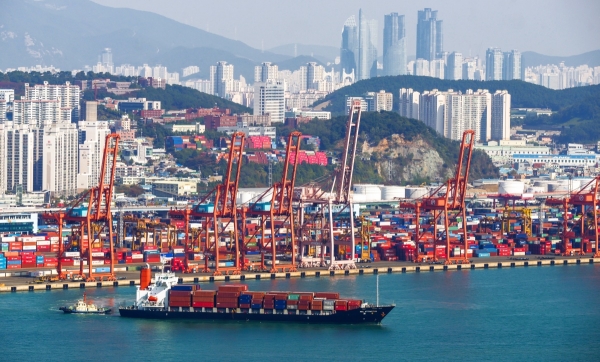
South Korea posted exports worth $45.8 billion in November, increasing by 4 percent on-year while rebounding from a 3.8 percent drop last month.
The country's daily exports in November also rose 6.3 percent on-year, marking the first time since November 2018 that both monthly and daily exports increased.
Exports from March to August exhibited on-year decreases due to the pandemic-triggered economic fallout, bouncing back in September with a 7.3 percent increase.
However, it dropped again in October by 3.8 percent on-year.
The Trade Ministry said the nation’s exports have surpassed the $40 billion bar for the third consecutive month. The ministry expected the upward momentum to continue down the road.
The rebound in exports was attributed to robust overseas sales of IT products.
Exports of chips surged 16.4 percent on-year to mark $8.5 billion, marking its fifth consecutive month to increase.
Memory chips accounted for 19 percent of South Korea's monthly exports in November, reaching $27.2 billion and surpassing the record high for annual exports in 2018, due to the strong demand for new mobile devices and laptop computers.
Exports of other IT products also substantially increased, with displays up 21.4 percent on-year to $1.9 billion and mobile devices increasing 20.2 percent to $1.4 billion.
Outbound shipments of biohealth products soared 78.5 percent on-year to $1.4 billion due to robust sales of COVID-19 test kits.
Automobile exports advanced for the third consecutive month to $3.9 billion, due to strong demand for SUV and eco-friendly vehicles.
Petroleum product exports, however, plummeted by 50.6 percent on-year to $1.6 billion, marking the third consecutive month to post a decrease of over 40 percent.
South Korea’s November exports to its four major destinations all increased, with those to Europe jumping by 24.6 percent and those to the US climbing by 6.8 percent.
Exports to China increased 1 percent on-year and those to other Asian nations rising 6.4 percent.
Meanwhile, South Korea’s imports fell 2.1 percent on-year to $39.8 billion in November.







