


 Trump’s Iran Strategy: What Has Been Achieved After Three Months of Conflict?
  Silver Cracks Key 365-Day EMA for First Time Since Feb 2024; Bears Eye $50 on Rallies
  Malaysia Central Bank Moves to Support Ringgit Amid Foreign Fund Outflows
  FxWirePro- Major Pair levels and bias summary
  FxWirePro: USD/CAD hits 14-month high , Scope for further upside
  FxWirePro:NZD/USD rout continues without relief
  FxWirePro: USD/ZAR slips as dollar weakens after PCE inflation data
  AI Memory Boom Sparks Global Chip Supply Crunch
  FxWirePro: USD/ZAR remains buoyant, looks to extend gains
  Indian Government Bonds Seen Opening Steady Ahead of RBI Policy Decision
  FxWirePro: GBP/AUD sustains gains as uptrend remains strong
  FxWirePro:GBP/USD recovers slightly from early decline but bears are not done yet
  AUDJPY Bears Take a Breather at 111.50, But ‘Sell on Rallies’ Still Eyes 110


The Bank of Canada in October held interest rates, but painted a gloomy picture of the Canadian economy. The BOC noted that weak oil prices have had a negative impact on the export sector and hurt economic growth. In its monetary policy report the c.bank said that the Canadian economy will grow just 2 per cent in 2016 and 2.5 per cent in 2017, lower than the previous forecasts of 2.3 per cent and 2.6 per cent.
Tanking commodities has seen the Canadian economy decouple from the US economic locomotive. For almost two years, Canada's single most important industry, oil and gas production, has been devastated by the glut of petroleum products on world markets. Under these circumstances, policymakers will likely prefer to see the CAD stay relatively soft. The BoC has frequently stressed the "shock-absorbing" role of a flexible exchange rate in helping the Canadian economy cope with exogenous shocks.
"The persistent low level of oil prices means that capital spending in the oil patch is likely to decline again in 2016. That is a key headwind to growth in the overall economy, which we expect to remain quite modest over the medium term," said economist Leslie Preston of Toronto-Dominion Bank.
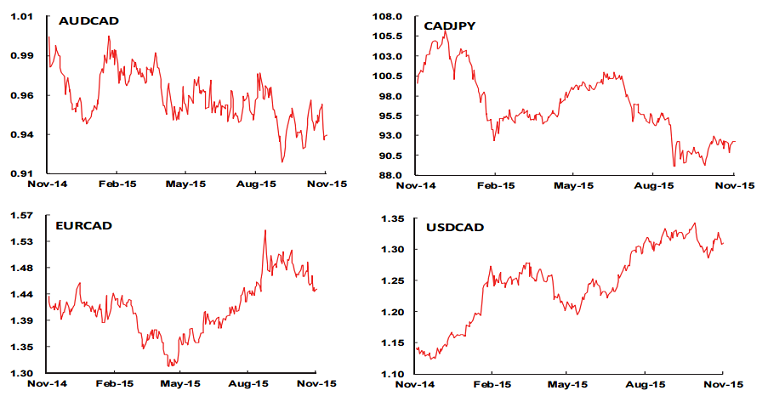
From a chart perspective, there is little doubt that the mid-year rally in USD/CAD has lost some momentum. Consolidation is the order of the day, and could extend for some time. USD/CAD edged higher to 1.3278 last week but lost momentum and retreated. CAD will retain a softer tone as investors re-price the bottoming out of the bearish commodity market cycle in the context of accommodative monetary policy. Interest rate differentials and low oil prices will move against the Canadian dollar as US interest rates rise.
"Assuming the Fed reaches lift-off before year-end, we think a combination of higher US rates (and wider yield spreads versus the CAD) and low oil prices will lift USD/CAD to just below 1.40 in H2 2016", notes Scotiabank in a research report.
However, the Canadian economy has started to recover from the contraction in the first half of 2015, led by exports - particularly in the transportation and aerospace industries - residential investment, and consumer spending. Despite the first half contraction, the labour market has continued to add jobs at a moderate pace, with positive momentum in the service sector and construction activity. Vehicle sales are at record highs, and auto production is picking up after an extended period of retooling in the first half of the year.
"We look for seasonal patterns to help out; the USD usually does well against the CAD late in Q4 and early in H1 of the following year. From here, gains above 1.3250 will be positive for the USD and we expect solid USD support on weakness to the 1.28 area", adds Scotiabank.
In today's trade, the pair has edged above the 1.31 handle, and currently is trading at 1.3105, bias is on the downside. Failure above 1.3218 (61.8% retrace of the 1.2457-1.2832 fall) on Oct 29th and daily close back below daily cloud yesterday is hurting bulls.

- News

- Economy

- Central Banks
- Investing
- Research
- Roundups
- Digital Currency
- Insights
- Technical Analysis
- Technology
- Business
- Law
- Health
- Nature
- Fintech
- Science
- Topic
- Opinions
- ©Econometrics LLC . All Rights Reserved.
Consolidation in USD/CAD to extend further, higher U.S rates, lower oil prices to weigh
Tuesday, November 3, 2015 11:28 AM UTC
Editor's Picks



- Market Data
Most Popular




