


 Gold Prices Fall Below $4,000 as Strong Dollar, Fed Rate Hike Bets Weigh on Bullion
  South Korea Remains MSCI Emerging Market Despite Reform Progress
  Japan Signals Preference for Low Interest Rates as BOJ Policy Debate Intensifies
  Bessent Says U.S. Must Strengthen Supply Chains and Economic Security
  Oil Prices Drop as Strait of Hormuz Shipping Recovers
  Wall Street Ends Mixed as Micron Surges, Apple Drops After Price Hikes
  White House Seeks $87.6 Billion Emergency Funding for Iran War, Farmers, and Ebola Response
  Asian Currencies Trade Mixed as Yen Hovers Near 40-Year Low, Dollar Holds Firm on Fed Outlook
  Gold Prices Rise Above $4,000 as Inflation Data and Weaker Dollar Boost Demand


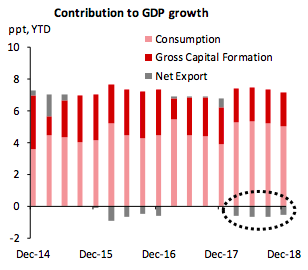
China’s real GDP growth fell further to 6.4 percent y/y in 4Q18 from 6.5 percent in 3Q18 as expected. Net export continued to drag the overall performance for the fourth straight quarter in spite of slumping oil price.
This largely mirrored the negative export growth in December after front-loading activities ended. The monthly data pointed to a grim outlook for 1Q19. Retail sales inched up to 8.2 percent y/y in December from 8.1 percent in November, staying at the lowest range since 1999.
Expenditure on most other discretionary goods such as cosmetics, jewellery, and automobile remained weak. Obviously, consumer confidence has been sapped by job insecurity and slower wage growth.
Fading credit impulse on the back of regulation tightening points to further weakness ahead. Infrastructure investment was a bright spot; growth was positive for a second consecutive month (5.7 percent in December vs 2.5 percent in November (3mma)).
The National Development and Reform Commission (NDRC) greenlighted RMB1.2 billion worth of infrastructure projects in 4Q18, the highest in three years.
"We expect the quota of special bond issuance (excluded from official budgets) to increase to RMB2 trillion in 2019 from RMB1.35 trillion last year. Off-budget expansions will likely include the re-launching of special construction fund," DBS Research commented.







