


 Dollar Slides as Softer US Inflation Dims Fed Rate Hike Expectations
  Goldman Sees Foreign Investors Driving India Stock Market Recovery
  Oil Prices Surge as U.S.-Iran Conflict Escalates and Strait of Hormuz Risks Grow
  European Stocks Slip as Middle East Tensions and Hormuz Threat Rattle Markets
  Gold Price Holds Near $4,000 as Middle East Tensions and Fed Rate Hike Bets Grow
  Gold Prices Fall Amid Rate Jitters; Copper Steady as China Stimulus Eyed
  FxWirePro: Daily Commodity Tracker - 21st March, 2022


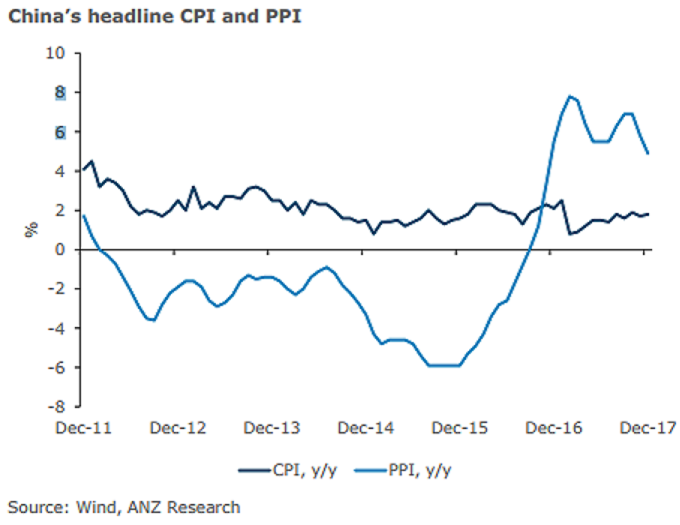
China’s consumer inflation is expected to trend higher in 2018 with a 2.6 percent annual rise, supported by prices of food and services. Food prices may record an increase in 2018 on a y/y basis due to the resumption of the “pork cycle” and a low base effect in 2017, ANZ Research reported.
In fact, food inflation has edged up on an m/m basis since August 2017, recording 1.1 percent in December. In addition, services inflation should retain a strong uptrend, benefitting from good demand.
China’s inflation momentum picked up in December as both PPI and CPI registered sequential increases. Food prices, which fell 1.4 percent y/y, were the major pullbacks to the headline measure in 2017 on a y/y basis. The prices of consumer goods in the PPI basket edged higher only by 0.7 percent y/y in 2017, mirroring the sluggish CPI. On the other hand, prices of production goods boosted the PPI, thanks to strong price movement in commodities, such as steel and coal.
China’s capacity reduction programme for steel and coal will likely be completed in 2018 and extended to other sectors. Producer prices will continue to hold up. The Chinese authorities recently issued a document to the steel, cement, and glass industries, reinforcing curbs on output and displaying strong political will.
"Apart from the deleveraging campaign, the inflationary outlook supports our call for a further upward adjustment in the open market operation rate by 35 basis points in 2018. We also expect the 10-year government bond yield to reach 4.35 percent by the end of the year," the report added.
Meanwhile, FxWirePro has launched Absolute Return Managed Program. For more details, visit http://www.fxwirepro.com/invest







