


 Citi Raises TSMC Price Target as AI Chip Demand Strengthens Growth Outlook
  Alcohol is one of the most dangerous drugs, yet its presence is ubiquitous in social settings and celebrations
  Gold Pulls Back After Hitting $4,180 as Geopolitical Risk Sends Crude Higher
  In a rebuke to Trump, the Supreme Court rules that birthright citizenship is the law of the land
  Trump has made more than $1 billion from crypto in a year. How?
  Bernstein Names IAG, Ryanair as Top European Airline Stocks Ahead of Earnings
  JPMorgan Cuts Gold Price Forecast, Sees Bullion Reaching $4,500 by End of 2026
  Elon Musk is remaking the world, like Henry Ford before him – but more dangerously
  Goldman Sachs Raises USD/JPY Forecast, Sees Yen Weakness Persist Through 2027
  Gold Surges Past $4150 on Dovish Fed Signals and Weak Jobs Data; Bullish Outlook Prevails
  Goldman AM Sees Strong Buyout Opportunities in Japan, South Korea and Australia
  State of emergency in Crimea as Ukraine focuses pressure on ‘jewel in Putin’s crown’
  USA at 250: the Black American struggle for life, liberty and the pursuit of happiness


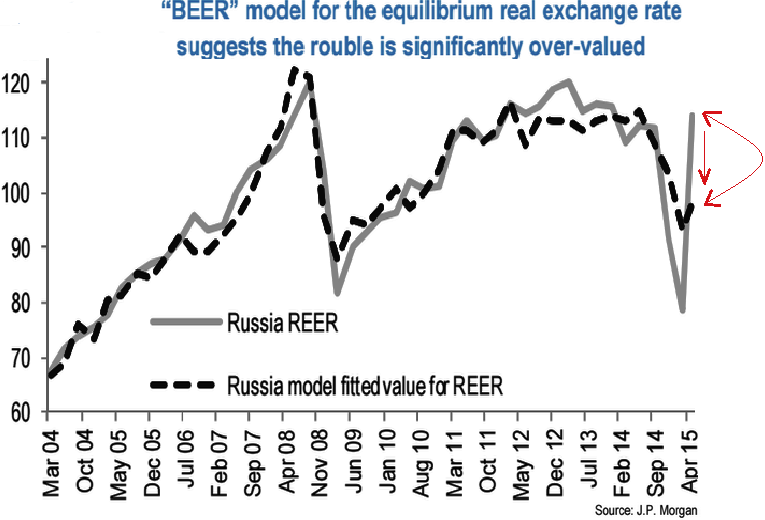
We estimate a Behavioral Equilibrium Exchange rate model for Russia to establish to what extent REER movements have been driven by an adjustment to its equilibrium values, consistent with changing fundamentals.
Although the rubles nominal exchange rate is closely nearing to fair value in short-term models given the price of oil and sovereign credit spreads, the REER seems overpriced at present levels.
Retreating Russia's REER against oil prices and productivity differentials relative to the US and euro area (BEER model for equilibrium) advocates that it is now around 15% overvalued as diagram shows.
The estimates of the speed of convergence of the real exchange rate to its equilibrium value suggests that around 60% of the valuation gap should close in the next two quarters implying a 9% REER depreciation over the course of two quarters.
Catalysts for deprecation over the summer include an acceleration of FX reserve accumulation, diminishing use of the FX repo facility, and a seasonal deterioration of the current account and external debt repayments.

- News

- Economy

- Central Banks
- Investing
- Research
- Roundups
- Digital Currency
- Insights
- Technical Analysis
- Technology
- Business
- Law
- Health
- Nature
- Fintech
- Science
- Topic
- Opinions
- ©Econometrics LLC . All Rights Reserved.
BEER model suggests REER of RUB to contrast
Wednesday, June 3, 2015 8:01 AM UTC
Editor's Picks



- Market Data
Most Popular




