


 Goldman Sachs Flags 3 Key Risks Ahead of Europe’s Earnings Season
  Gold Price Today: Gold Slips as Dollar Rebounds Ahead of Fed Minutes
  China Services PMI Beats Forecasts as Strong Demand Supports June Growth
  Oil Prices Steady as U.S.-Iran Peace Talks Ease Strait of Hormuz Supply Fears
  Gold Price Today: Bullion Heads for First Weekly Gain as Weak U.S. Jobs Data Eases Rate Hike Fears
  Dollar Rebounds as Euro, Pound Slip Ahead of Fed Minutes, Yen Near Intervention Zone
  European Stocks Hold Steady as Consumer Shares Rise, AI Tech Selloff Weighs on Markets
  Oil Prices Rise as Strait of Hormuz Risks Offset OPEC+ Supply Increase
  Japan Signals Readiness to Act on Yen as Intervention Speculation Grows
  New Zealand Consumer Confidence Rises in June as Inflation Expectations Ease
  Gold Price Drops as Strong Dollar and Fed Rate Outlook Weigh on Bullion
  US Stock Futures Slip as Fed Minutes, Earnings Season Take Center Stage
  Gold Price Rises as Softer Dollar and Fed Rate Expectations Boost Bullion Demand
  US Stock Futures Rise as Investors Eye Fed Minutes, AI Stocks, and Q2 Earnings
  Goldman Sachs Raises USD/JPY Forecast, Sees Yen Weakness Persist Through 2027
  China 618 Smartphone Sales Drop 13% as Higher Prices Hurt Demand, Huawei Gains Market Share
  South Korea’s KOSPI Plunges as Samsung, AI Chip Stocks Trigger Market Sell-Off


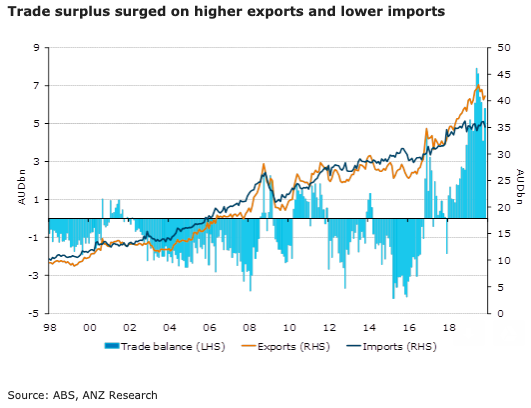
Australia’s trade surplus surged to AUD5.8bn in November, well above our and market expectations. The rise in the trade surplus was from a combination of higher exports and lower imports, up 1.8 percent m/m and down 2.8 percent m/m respectively. Stronger resources and services exports drove most of the increase.
By our reckoning, the stronger resource export figure reflects an increase in volume. Imports on the other hand were down, with a particularly sharp decline in consumption goods. This decline is further indication that household spending is subdued.
Total resource exports rose 0.9 percent m/m in November and are now 3 percent higher than a year ago. The increase largely reflects higher iron ore exports, which rose 2.1 percent m/m, as well as LNG, up 0.9 percent m/m. These rises were partially offset by a sharp decline in non-monetary gold, which fell 6 percent m/m, continuing the strong decline in the previous month.
The RBA’s commodity price index was down 3.8 percent in November, which suggests that the rise in resource exports was likely due to a rise in volume. Manufacturing exports had a soft month, down 0.3 percent m/m, which follows the large rise in the previous month. Service exports continued to rise, up 1.1 percent m/m, leaving them 8.9 percent higher than a year ago.
Consumption imports fell 6.6 percent m/m, leading the fall in imports. A large part of this was driven by a 20.7 percent m/m decline in car imports, which are now down over 19 percent y/y. The capital goods imports figure was the other large fall for the month, declining 3.9 percent m/m. Fuel imports were down 4.9 percent m/m, largely reversing the sharp rise the previous month.
"Looking forward to last December’s trade balance figures and the next two quarters, we will be looking for any impact from the bushfires on tourism-related expenditure," ANZ Research commented in its latest report.







