


 Japan, U.S. Discuss Yen Weakness as Currency Intervention Concerns Grow
  Singapore Inflation Stays Muted in May as Core CPI Misses Forecasts Ahead of MAS Review
  South Korea’s KOSPI Rebounds as Samsung and SK Hynix Lead Tech Stock Recovery
  Malaysia Central Bank Moves to Support Ringgit Amid Foreign Fund Outflows
  South Korea Remains MSCI Emerging Market Despite Reform Progress
  Gold Prices Mixed as Stronger Dollar Offsets Safe-Haven Demand Amid U.S.-Iran Peace Talks
  Yen Near 40-Year Low as USD/JPY Approaches Key 162 Level, Raising Intervention Concerns
  Gold Price Rises as Investors Weigh U.S.-Iran Talks and Fed Policy Outlook
  Wall Street Ends Mixed as Alphabet Slumps, Middle East Developments and Fed Outlook Weigh on Markets
  Russian Stocks End Flat as MOEX Index Hits New 52-Week Low


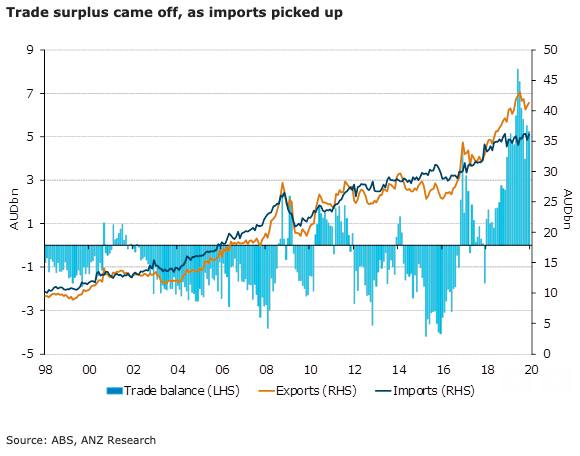
Australia’s trade surplus fell slightly to AUD5.2 billion in December, below market expectations. The decline was driven by a larger rise in imports compared to exports. Imports rose 2.4 percent m/m, while exports were up 1.4 percent m/m.
Stronger resource exports were the primary drivers of the pick-up in exports, while service exports fell. Imports were up across the board, with sharp rises in capital and consumption goods imports.
Total resource exports rose 2.9 percent m/m in December and are now 12.1 percent higher than a year ago. The increase largely reflects higher iron ore exports, which rose 3.3 percent m/m, as well as LNG, up 2.6 percent m/m.
Non-monetary gold continued its recent volatility rising 14 percent m/m after declining 6 percent in the previous month. The RBA’s commodity price index was down 1.1 percent in December, which suggests that the rise in resource exports was likely due to a rise in volume.
Manufacturing exports continued to decline, by 3.3 percent m/m. Service exports had the first material decline in some time, falling 1.1 percent m/m.
Capital goods were up 6 percent m/m, leading the increase in imports. A large part of this was due to increased transport equipment imports, which rose 23 percent m/m. Consumption goods had a strong month, largely reversing the decline from November. Fuel imports, for example, were up 4.7 percent m/m.
"Given the preliminary December quarter trade balance, net exports are unlikely to contribute much to GDP growth," ANZ Research commented in its latest report.







