


 Fed’s Williams Signals One More Rate Hike Before Year-End
  Oil Prices Surge Above $106 After Deadly Saudi Airport Attack
  Crypto Derivatives Dashboard: Bulls Retain Control Amid $488M Liquidation Flush
  RBA Signals More Rate Hikes as Inflation Risks Rise
  Fed’s Hammack Says Bond Yield Surge Is Not Driven by Inflation Fears
  Yen in Focus as BOJ, Fed Rate Hikes Reshape Currency Markets
  Trump Calls for Zelenskyy Replacement Amid Russian Diesel Deal
  Navigating the Crypto Pulse: Weekly Market Resilience and Institutional Inflows
  Ripple-Backed Evernorth Set for Nasdaq Debut With 473 Million XRP
  Deutsche Bank CEO Urges Faster German Economic Reforms
  Oil Prices Fall as Trump Ceasefire Claim Shifts Market Focus to U.S. CPI
  Cardano Hits Five-Year Transaction Record as ADA Price Falls
  Visa Wins China Approval to Prepare Domestic Payments Expansion
  Bank of America Predicts Yen Rebound as USD/JPY Faces Risks
  Philippines Current Account Deficit Seen at $19.1 Billion in 2026
  BlackRock’s Rick Rieder Favors Bonds Over Stocks as Treasury Yields Surge


 Add as a preferred source on Google
As expected by markets the RBA held interest rates at 1.5 percent at its October monetary policy meeting and refrained from adopting an explicit easing bias. Having eased monetary policy at its May and August meetings, the board judged that holding the stance of policy unchanged at this meeting would be consistent with sustainable growth in the economy and achieving the inflation target over time.
Inflation is a key consideration when it comes to the outlook for Reserve Bank of Australia's monetary policy. The Australian government publishes official CPI figures every quarter, and Q3 CPI data due for release on Oct 26 will be important in assessing any implications for monetary policy.
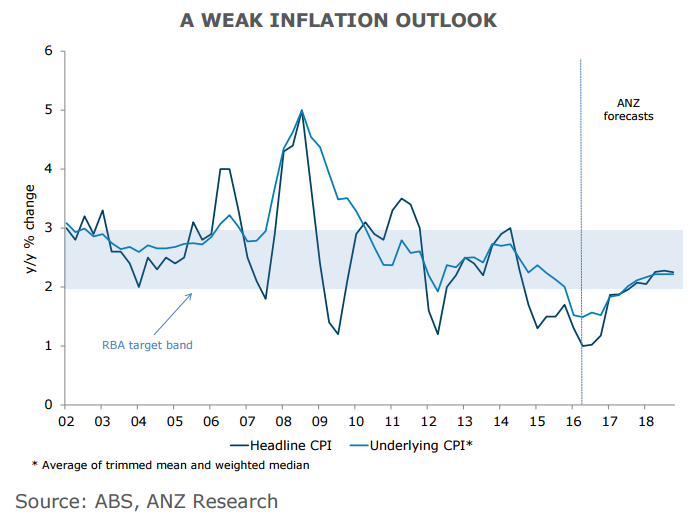
According to ANZ, the headline CPI is forecast to have risen by 0.5 percent q/q in Q3, slightly higher than the 0.4 percent q/q Q2 outcome, leaving annual inflation steady at 1 percent y/y. Trimmed mean is expected to have risen by 0.3 percent q/q and the weighted median by 0.4 percent q/q.
A private measure of Australian inflation expectations rose in October for the first time in three months, a sign that central bank policies were finally translating into faster price growth. The Melbourne Institute’s 12-month gauge of inflation expectations rose to 3.7 percent in October, from 3.3 percent the previous month. Last week, the Melbourne Institute said consumer inflation rose 0.4 percent in September and was up 1.3 percent on an annualized basis. That was the highest monthly reading since July.
In its recent communication, the RBA has sounded comfortable about policy settings. Australia's domestic economy looks more robust, commodity prices have risen and the property market has re-energised. The changes to the statement on the conduct of monetary policy have increased the RBA’s ability to tolerate below-target inflation on financial stability grounds.
"We expect Q3 CPI data to show that underlying inflation has remained weak. This would complicate the monetary policy outlook, although we don’t expect the RBA to mechanically respond to a low result," said ANZ in a report to clients.
AUD/USD bounces off from lows near the 0.75 handle and was trading around 0.7563 at around 11:45 GMT. The pair was back in the green, trading above 100-DMA support at 0.7532. Upside, for now, seems capped by 5-DMA at 0.7571. Technical indicators are bearish. Close below 100-DMA could see further drag.







