


 Gold Prices Fall Amid Rate Jitters; Copper Steady as China Stimulus Eyed
  New Zealand Fast-Tracks Gold Mining as Industry Revival Gains Momentum
  Bessent Says U.S. Must Strengthen Supply Chains and Economic Security
  South Korea Remains MSCI Emerging Market Despite Reform Progress
  FxWirePro: Daily Commodity Tracker - 21st March, 2022
  Oil Prices Slip as Iran Sanctions Relief and Hormuz Shipping Recovery Ease Supply Concerns
  Trump Requests $11 Billion More in Farm Aid as Rising Costs Pressure U.S. Farmers
  Gold Falls Below $4,000 as Strong Dollar and Fed Rate Hike Expectations Weigh on Prices
  Best Gold Stocks to Buy Now: AABB, GOLD, GDX


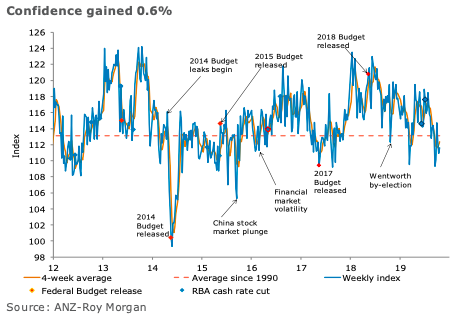
Australia’s ANZ-Roy Morgan consumer confidence made a partial recovery last week, rising 0.6 percent after the prior week’s 1.2 percent drop. Current finances dropped 2.4 percent, however. This component is now down nearly 10 percent from its August high. Future finances gained 0.4 percent, taking it back above its long term average.
Current economic conditions gained 0.3 percent, while future economic conditions declined by 1.1 percent. Both the sub-indices are below their long-term average.
The ‘Time to buy a household item’ measure gained 5.1 percent. There have been some big up and down swings in this measure in recent months, but it remains below its long-run average. Inflation expectations were stable at 4.1 percent.
"Confidence eked a small gain on the back of a strong rebound in the ‘Time to buy a household item’ sub-index. Outside of this, the results were mixed, perhaps reflecting the news flow over the week. On the positive side, Australia’s unemployment rate moved lower on the back of a decent employment report. But the IMF’s downgrade to Australia’s economic outlook attracted a lot of attention, as did the slowdown in China’s data. Of particular note, current finances dropped 2.4 percent – the second big fall in the past three weeks. This measure is still well above average, but is now down close to 10 percent from its August high. If consumers lose confidence in their own finances when they are also worried about the broader economic outlook then there may be a material impact on spending," said David Plank, ANZ’s Head of Australian Economics.







