


 Gold Drops Below $4,000 as Strong US Dollar and Fed Rate Hike Expectations Pressure Bullion
  BOJ Hawk Signals Faster Interest Rate Hikes Amid Inflation Risks
  Singapore Inflation Stays Muted in May as Core CPI Misses Forecasts Ahead of MAS Review
  Australia Inflation Cools in May, But Core CPI Keeps RBA Rate Hike Risks Alive
  Bank Regulation Rollbacks in the U.S. and UK Could Increase Financial Risks, Study Warns
  White House Seeks $87.6 Billion Emergency Funding for Iran War, Farmers, and Ebola Response
  US Dollar Climbs to One-Year High as Fed Rate Hike Expectations Surge
  FxWirePro: Daily Commodity Tracker - 21st March, 2022
  Malaysia Central Bank Moves to Support Ringgit Amid Foreign Fund Outflows
  Oil Prices Rebound as Strait of Hormuz Tensions Return After Ship Attack Near Oman
  U.S. Dollar Reaches One-Year High as Tech Sell-Off and Fed Rate Hike Expectations Support Demand
  Wall Street Ends Mixed as Tech Stocks Struggle Ahead of Micron Earnings


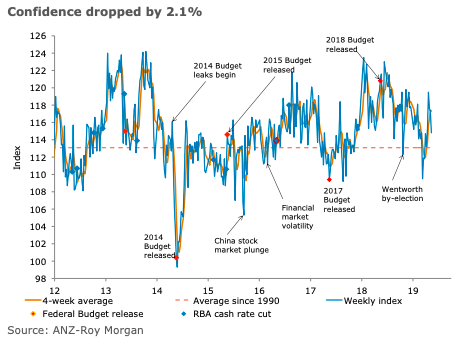
Australia’s ANZ-Roy Morgan consumer confidence fell by 2.1 percent last week, closing below its four-week moving average but remaining above the long-term average.
Financial conditions were not the cause of the fall, with current finances up 2 percent, while future finances rose 1.4 percent.
Economic conditions dropped sharply, however, with current economic conditions down a massive 8.1 percent, continuing their recent volatile pattern, and future economic conditions falling 3.3 percent.
The 'time to buy a household item' also did not help, falling 2.5 percent. The four-week moving average for inflation expectations rose by 0.2ppt to 4.2 percent.
"The fall in consumer sentiment follows a couple of important developments. Domestically the RBA decided to leave interest rates unchanged after considerable speculation that a rate cut might occur. Globally, the US-China trade dispute resumed with the US increasing tariffs on a wide range of goods. At this stage, consumers see these events as more damaging for overall economic prospects than their own finances. After a period of weakness, inflation expectations jumped to 4.5 percent for the week, pushing the four week moving average to 4.2 percent – its highest level since the end of January. The uptrend in petrol prices over the last few weeks may have supported inflation expectations," said David Plank, ANZ’s Head of Australian Economics.







