


 Asian Stocks Sink as Apple Price Hikes Spark AI Valuation Fears, South Korea and Japan Lead Selloff
  US Dollar Slips After PCE Inflation Data as Fed Rate Hike Expectations Stay Elevated
  Asian Markets Rally as Micron and Qualcomm AI Outlook Lifts Global Tech Stocks
  US Dollar Slips After PCE Inflation Data Eases Fed Rate Hike Expectations
  Japan Signals Preference for Low Interest Rates as BOJ Policy Debate Intensifies
  Gold Prices Fall Below $4,000 as Strong Dollar, Fed Rate Hike Bets Weigh on Bullion
  Gold Falls Below $4,000 as Strong Dollar and Fed Rate Hike Expectations Weigh on Prices
  Bank Regulation Rollbacks in the U.S. and UK Could Increase Financial Risks, Study Warns
  Trump Requests $11 Billion More in Farm Aid as Rising Costs Pressure U.S. Farmers


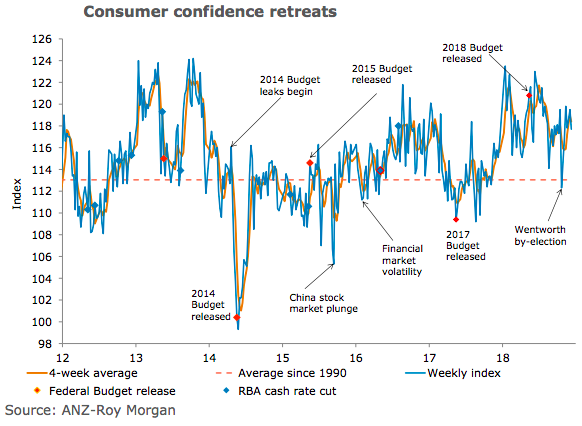
Australia’s ANZ-Roy Morgan consumer confidence fell 1.5 percent, reversing the gains seen over the previous two weeks. Consumer sentiment remains well above its long-run average, however.
Financial conditions sub-indices were mixed, with current financial conditions down 0.7 percent, while future financial conditions were up 1.7 percent. Economic conditions readings were also mixed, with current economic conditions falling by a sharp 6 percent while future economic conditions were up a modest 0.3 percent.
The 'time to buy a household item' sub-index was down 2.8 percent, its second straight loss after it made a solid gain in the second half of November. Four-week moving average inflation expectations were stable at 4.2 percent.
"A more cautious RBA statement on Tuesday and then the soft Q3 GDP figures Wednesday may have impacted consumer views on current economic conditions, which fell a sharp 6 percent. Global equity volatility may also have impacted sentiment. On the other hand, current financial conditions were only down a touch after a very strong gain the previous week and future financial conditions were up. This suggests consumers are still feeling good about their own circumstances, which is somewhat at odds with the weak wage data in the Q3 GDP report," said David Plank, Head of Australian Economics, ANZ Research.







