


 South Korea Stocks Tumble as AI-Fueled Rally Faces Profit-Taking Pressure
  Japan Keeps Markets Guessing as Yen Nears 40-Year Low, Raising Intervention Risks
  South Korea’s KOSPI Rebounds as Samsung and SK Hynix Lead Tech Stock Recovery
  Asian Stocks Slip as Oil Rebounds Amid Fed Rate Hike Fears
  Gold Falls Below $4,000 as Strong Dollar and Fed Rate Hike Expectations Weigh on Prices
  Oil Prices Drop as Strait of Hormuz Shipping Recovers
  US Dollar Hits One-Year High as Hawkish Fed Outlook Overshadows Middle East Developments
  Bessent Says U.S. Must Strengthen Supply Chains and Economic Security
  Gold Prices Mixed as Stronger Dollar Offsets Safe-Haven Demand Amid U.S.-Iran Peace Talks
  Wall Street Ends Mixed as Alphabet Slumps, Middle East Developments and Fed Outlook Weigh on Markets
  Australia Inflation Cools in May, But Core CPI Keeps RBA Rate Hike Risks Alive
  Oil Prices Slip as Iran Sanctions Relief and Hormuz Shipping Recovery Ease Supply Concerns


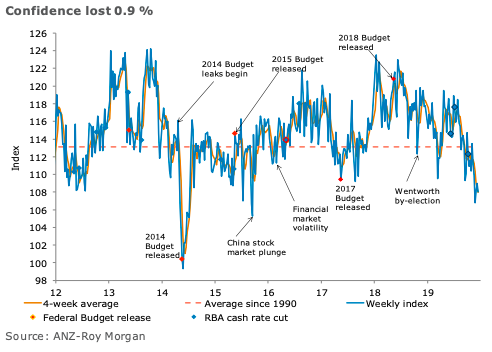
Australia’s ANZ-Roy Morgan consumer confidence fell 0.9 percent last week, primarily due to the 6.4 percent fall seen in the ‘Time to buy a major household item’ sub-index.
Financial conditions were mixed with ‘current finances’ down by 1.5 percent, while ‘future financial conditions’ gained 3.7 percent. Economic conditions were also mixed.
‘Current economic conditions’ rose 1.6 percent, while ‘future economic conditions’ were down 1.2 percent. The four-week moving average of ‘inflation expectations’ was up 0.1ppt to 4.0 percent.
"Momentum fizzled out this week after two successive weekly gains. A delayed response to the soft GDP result and weak retail sales may be at work, as well as the news flow around the bush fires and associated smoke haze. The weakness seen in the ‘time to buy a household item’ sub-index was almost enough to take it to its lowest level since the global financial crisis. It seems the turn in the housing market has not yet flowed through to sentiment around household items. We note that consumer confidence is not the be all for financial conditions. The financial wellbeing of Australians is holding up better," said David Plank, ANZ’s Head of Australian Economics.







