


 Japanese Yen Rebounds as Trump Flags Currency Weakness
  U.S. Dollar Hits Two-Month High as Oil, Treasury Yields Surge
  US Stock Futures Fall as Treasury Yields Surge Ahead of Trump-Xi Summit
  Dollar Falls as Oil Eases, Yen Jumps on Intervention Signals
  Gold Prices Fall as Treasury Yields Rise on Fed Rate Hike Bets
  China Agrees to Buy 20 Million Tons of U.S. Coal
  Asian Stocks Fall as Surging Bond Yields Rattle Markets
  Japanese Bank Stocks Surge as Bond Yields Fuel Rate Hike Bets
  Trump to Ease U.S. Fuel-Economy Standards
  ECB May Stop Rate Hikes After December, Capital Economics Says
  Gold Holds Near $4,275 as Rising Treasury Yields Fuel Fed Rate Hike Bets
  Fed Unveils Stablecoin Rules Under GENIUS Act
  Fed’s Hammack Says Bond Yield Surge Is Not Driven by Inflation Fears


 Add as a preferred source on Google
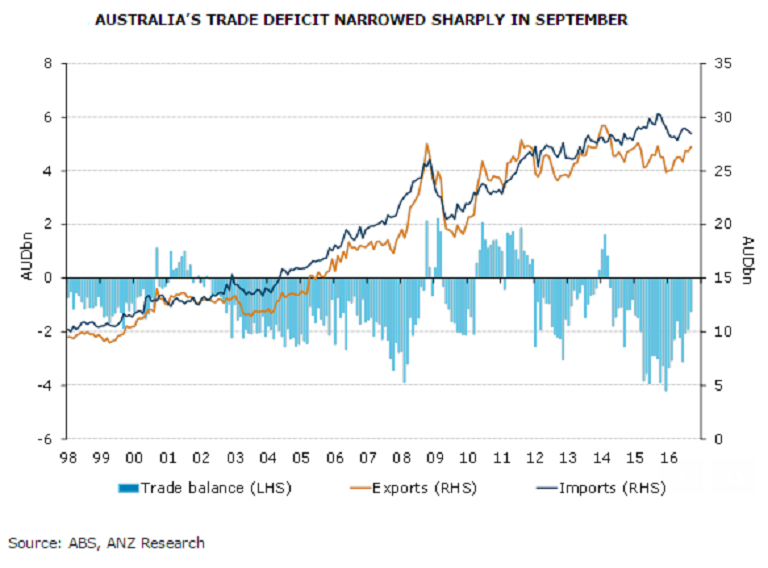
Australia’s trade balance improved during the month of September, driven by strong exports of coal and significantly beating market expectations. This surprise improvement was driven by a spike in resource exports, with consumer imports being a little weaker, leading to the decline.
The Australian trade deficit narrowed to AUD1.23 billion in September from an upwardly revised AUD1.89 billion in August, much better than the market consensus. Total exports rose 1.6 percent in September, with the increase concentrated in resource exports. However, gold exports, which tend to be very volatile, dropped a sizeable 19 percent in the month.
Exports excluding gold bounced a strong 4.0 percent in September. This strength in exports was largely driven by a rise in other resource exports, which were up 3.9 percent in September. While iron ore exports were unchanged, the value of coking exports spiked, up a sharp 12.1 percent, likely underpinned by strong price gains. LNG exports continued to rise at a moderate rate.
Imports dropped slightly, down 0.8 percent in September. The prime driver was weaker imports of consumption goods, down 2.8 percent, while capital goods imports (ex-aircraft) were marginally higher, up 0.2 percent in the month and intermediate goods rose a solid 2.2 percent.
Despite the stronger exchange rate, net tourism and education exports continued to increase at a solid rate, up 4 percent in September. The Reserve Bank of Australia maintained its key benchmark rate at a record low of 1.50 percent in its November 1 monetary policy meeting, judging that unchanged policy is consistent with growth and inflation targets.
Meanwhile, the benchmark Australia's S&P/ASX 200 index traded 0.65 percent higher at 5,197.5 by 05:00 GMT.







