


 FxWirePro: Daily Commodity Tracker - 21st March, 2022
  Singapore Inflation Stays Muted in May as Core CPI Misses Forecasts Ahead of MAS Review
  Asian Stocks Slip as Oil Rebounds Amid Fed Rate Hike Fears
  South Korea Remains MSCI Emerging Market Despite Reform Progress
  U.S.-Iran Diplomacy Helps Drive Gasoline Prices Down 15% From May Highs
  Best Gold Stocks to Buy Now: AABB, GOLD, GDX
  New Zealand Fast-Tracks Gold Mining as Industry Revival Gains Momentum
  Gold Prices Fall Amid Rate Jitters; Copper Steady as China Stimulus Eyed


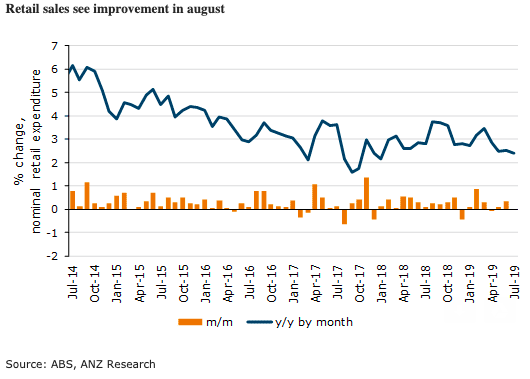
Australia’s retail sales grew by 0.4 percent in August, below ANZ and market expectations. This upgrade compared with recent months (0.2 percent m/m average for the last 6 months) represents the early effects of tax and rate cuts, ANZ Research reported.
Uncertainty about the labour market and other economic conditions may have caused some shyness among recipients of extra income - including early tax cut recipients and mortgagees (who can reduce payments as rates fall).
Annual growth increased to 2.6 percent. This is a little higher than the past few months, but still below the 1-yr, 3-yr and 5-yr averages.
Clothing was a standout, with 4.9 percent y/y growth after a strong monthly result (1.8 percent m/m). Department stores (1.1 percent m/m) and recreational goods (2.9 percent m/m) also saw strong monthly growth, hinting that tax cuts were stimulating short-term discretionary spending.
In y/y terms, key non-discretionary categories including supermarket and grocery stores (4.2 percent y/y) and pharmaceutical, cosmetics and toiletries (4.8 percent y/y) continued to see stronger growth than discretionary categories. This speaks to the longer term budget pressures on households, who are focusing more on “essentials” and less on “nice to haves”.
Monthly growth was strongest in QLD (0.8 percent m/m) and ACT (1.9 percent m/m) while annual results show strength in QLD and VIC, and weakness in NSW.







