


 Trump, Canada Reach Gordie Howe Bridge Deal Ahead of July 27 Opening
  Fed Chair Kevin Warsh Launches Task Forces to Overhaul U.S. Monetary Policy Framework
  Dollar Slips After Fed Minutes as Iran Tensions, Inflation Risks Keep Markets Cautious
  Oil Prices Slip but Stay on Track for Weekly Gains as U.S.-Iran Conflict Persists
  Gold Prices Fall Amid Rate Jitters; Copper Steady as China Stimulus Eyed
  Gold Prices Set for Weekly Loss as Iran Tensions and Fed Rate Outlook Weigh
  US Stock Futures Steady as US-Iran Tensions and Fed Inflation Concerns Weigh on Markets
  FxWirePro: Daily Commodity Tracker - 21st March, 2022
  Wall Street Rises as SK Hynix’s Record Nasdaq Debut Steals Spotlight Ahead of U.S. CPI Data


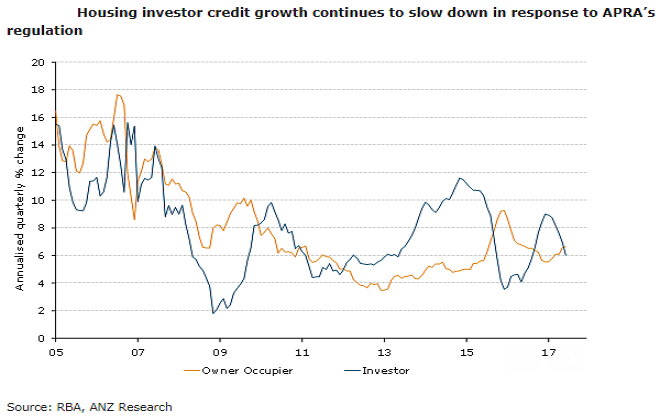
Australian private sector credit recorded a solid increase in June, led by a rebound in the business sector after several months of weakness. The divergence between the investors and owner-occupier housing credit continued, with the former still slowing in response to APRA’s macro-prudential regulation.
Housing credit posted another 0.5 percent m/m rise in June, although at the margin (2 decimal places) this was the slowest monthly increase in a year. The slowdown in investor borrowing continued, and quarterly annualized growth now sits at 6.0 percent.
On the other hand, credit to owner-occupiers again posted faster monthly growth than the investor segment. The divergence between the segments kept total annual housing credit growth at 6.6 percent y/y, reflecting a stabilization at a marginally higher rate than at the start of the year.
Business credit recorded the strongest monthly rise since December 2016, up 0.9 percent m/m. This is a welcome result after a period of weakness, but we do not expect it to be sustained indefinitely. Business finance approvals have remained weak in recent months, and suggest that growth in the stock of business credit is likely to ease from here, ANZ Research reported.
Meanwhile, FxWirePro launches Absolute Return Managed Program. For more details, visit http://www.fxwirepro.com/invest







