


 White House Seeks $87.6 Billion Emergency Funding for Iran War, Farmers, and Ebola Response
  Trump Threatens 100% Tariffs on Countries Imposing Digital Services Taxes on U.S. Tech Firms
  BOJ Hawk Signals Faster Interest Rate Hikes Amid Inflation Risks
  Asian Stocks Sink as Apple Price Hikes Spark AI Valuation Fears, South Korea and Japan Lead Selloff
  Morgan Stanley Sees Chinese Auto Market Recovery Gaining Momentum in Late Summer
  Best Gold Stocks to Buy Now: AABB, GOLD, GDX
  Gold Drops Below $4,000 as Strong US Dollar and Fed Rate Hike Expectations Pressure Bullion
  Gold Price Ends Lower for Fourth Week Despite Rebound as Fed Rate Hike Bets Strengthen


Australia’s business conditions fell again in October, from a downwardly-revised September result. This meant that conditions are now at the lowest level since November 2016.
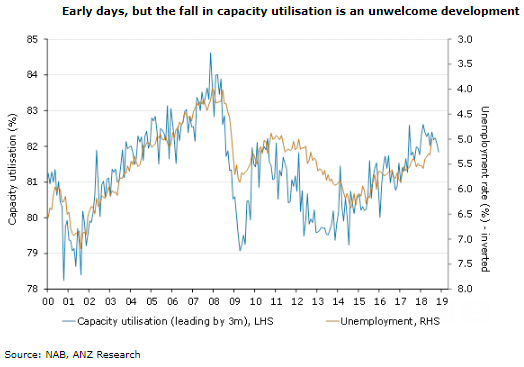
The details of the report were soft across the board. The two key components that give us a read on the labor market were down, with capacity utilization slipping to the lowest level in a year and profitability the lowest in two years. The drop in capacity utilization, in particular, is disappointing.
This had previously signaled that the labor market was in good shape, and markets have subsequently seen the unemployment rate fall to 5.0 percent. While only a very gradual fall in the unemployment rate was expected from here, further drops in capacity utilization would be cause for concern that unemployment could head back up from here.
Weakness in business conditions was evident across most industries, but the decline in the finance, business and property segment stands out. Conditions in the sector are now at the lowest level since 2015 and are well below the long-term average.
This is unsurprising given the weakness in the housing market and the ongoing impact of the Royal Commission. In brighter news, the construction sector bucked the trend in October with a solid increase in conditions, likely supported by the many infrastructure works across the country.







