


 South Korea Remains MSCI Emerging Market Despite Reform Progress
  Australia Inflation Cools in May, But Core CPI Keeps RBA Rate Hike Risks Alive
  Dollar Holds Firm as U.S.-Iran Talks Ease Tensions, GBP/USD Slips Amid UK Political Uncertainty
  Wall Street Slides as AI Stocks Tumble Following South Korea Tech Sell-Off
  Gold Prices Mixed as Stronger Dollar Offsets Safe-Haven Demand Amid U.S.-Iran Peace Talks
  Oil Prices Fall as Iran Peace Talks Progress, Hormuz Reopens, and U.S. SPR Hits 1983 Low
  Gold Price Rises as Investors Weigh U.S.-Iran Talks and Fed Policy Outlook
  Wall Street Ends Mixed as Alphabet Slumps, Middle East Developments and Fed Outlook Weigh on Markets
  Japan, U.S. Discuss Yen Weakness as Currency Intervention Concerns Grow


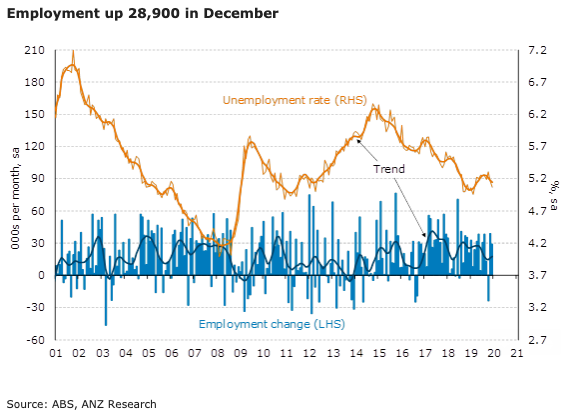
Australia’s employment report for the month of December showed a sharp progress, crossing market expectations as well, which in turn, dragged the unemployment rate down, thereby, reinforcing the RBA’s view that "the Australian economy appear[s] to have reached a gentle turning point."
Employment backed up its strong November result with a 28.9k rise in December. This was all due to part-time employment (+29.2k) while full-time employment fell by 300 workers. Since September, part-time employment has risen by 51.5k while full-time employment is down 8.0k.
The overall employment gain has driven the unemployment rate down to 5.1 percent in December from 5.3 percent in October. Underemployment was steady at 8.3 percent in December, despite the dominance of part-time employment gains. The participation rate was also steady at 66.0 percent.
Meanwhile, New South Wales (+20.6k) and Victoria (+10.3k) recorded the strongest December employment gains of the states.
"Accordingly, we are no longer forecasting a February rate cut. We still think further rate cuts are more likely than not over the course of 2020, however. Continued weakness in consumer spending and soft business investment suggest that progress toward lower unemployment will stall at a level that is inconsistent with the RBA achieving its policy objectives," ANZ Research commented in its latest report.







