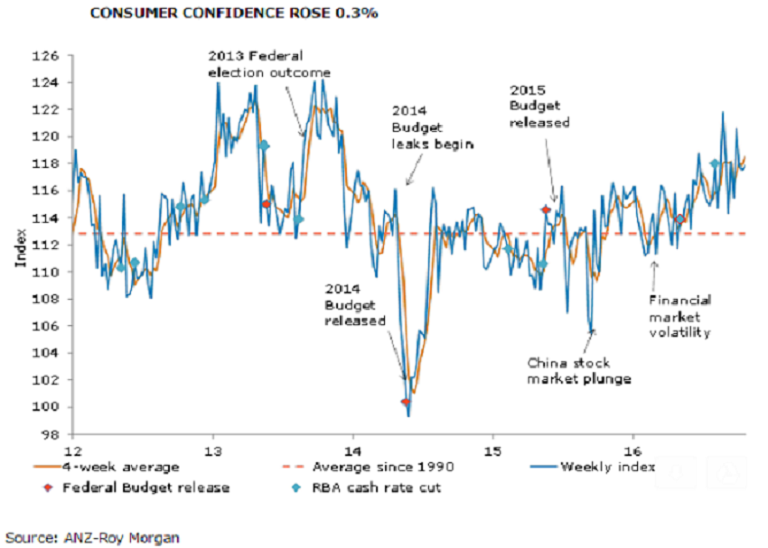
Consumer confidence in Australia edged higher during the week ended October 17, following growing optimism over the country’s housing and labor market and an upbeat economic outlook in the near term.
Australia’s ANZ-Roy Morgan consumer confidence edged higher by 0.3 percent in the week ending October 17, reversing the 0.3 percent fall last week. While the headline index has changed little over the past two weeks, there has been considerable variation in the sub-indices.
Further, consumers’ views towards their current finances fell 2.4 percent last week, while views towards future finances rose 1.0 percent. Both of these sub-indices remain well above their long-run averages.
Also, consumers remained slightly more confident of the economic outlook with the 12-month outlook improving by 0.4 percent. The 5-year ahead outlook was largely unchanged at +0.1%, following a 0.7 percent rise last week.
Meanwhile, household views on whether 'now is a good time to buy a household item' rose by a solid 2.0 percent.
"Confidence remains on an upward trend and well above its long-run average. A strong housing market and a declining unemployment rate are clearly supporting overall confidence. The key for the broader economic outlook, though, is whether rising confidence can translate into stronger spending, particularly given the high level of household debt," said Felicity, Emmett, Head, Australian Economics, ANZ.