


 BofA Names ASML Top Semiconductor Equipment Pick on Growth, Valuation
  Trump Buys SpaceX Shares After Record IPO
  New Zealand Moves to Ban Social Media for Children Under 16
  Nvidia AI Server Prices Set to Rise as Memory Costs Surge
  OpenAI AI Agent Swarm Behind Hugging Face Hack
  Luxshare Shares Rise as First-Half Profit Jumps 18%
  U.S. Probes Apex Logistics Over Nvidia AI Chip Shipments to China
  Salesforce Shares Surge as AI Demand Powers Q2 Earnings Beat
  Nvidia Eyes Perplexity Investment at $30 Billion Valuation
  Want to muck around with a real quantum computer? Now you can
  HP Stock Drops 9% Despite Q3 Earnings Beat and Raised 2026 Outlook
  Alibaba Raises $10.2 Billion to Expand AI Infrastructure
  New Zealand Labour Backs Social Media Ban for Under-16s
  Meta, U.S. States Discuss Settlement in Teen Addiction Trial
  Nvidia Reportedly Eyes $13 Billion Hugging Face Acquisition
  Countries Tighten Social Media Bans for Children


 Add as a preferred source on Google

Elon Musk is no stranger to highly competitive markets in which you take advantage of a competitor’s weakness. For once, he is on the receiving end as Meta launches its microblogging platform Threads to take advantage of his difficulties at Twitter.
Twitter, in effect, has been a near-monopoly in the realm of short pithy quotes from the well-known. It is the only platform offering brevity and controversy with such reach and such a high level of usage. Indeed, global news programmes pick up Twitter comments almost every day from the famous as a means of encapsulating a concept or view.
Donald Trump was a great exponent of unveiling new policies through Twitter. Whatever one thinks of him, Trump had a huge following on Twitter and boosted the platform’s profile. Musk has also made great use of it.
At the time of his bid, he was the world’s richest person and some would suggest the US$44 billion (£34.5 billion) he paid for Twitter was pocket money being spent in pursuit of his hobby. As Musk claims that he was protecting free speech as the likes of Donald Trump had been banned from using it by the previous CEO Jack Dorsey. Dorsey was joint founder of the business and someone with more liberal views than Donald Trump.
Paying too much?
In any event, Musk committed to the purchase just as tech business valuations were plummeting and some would suggest that he had paid almost twice what the business was worth. He tried to pull out of the deal realising he had over-bid for the business.
Boards are often accused of retrenchment when rebuffing bids and looking to protect their own jobs, power, status and pay. Board members are usually fired when a takeover bid is successful. In this somewhat unusual case, they successfully sued Musk to complete the deal at the original price.
Twitter had never consistently been able to monetise its popularity. For much of its life, it had been a loss maker. Musk realised that the business was a virtual monopoly and that he could charge users both for reading tweets and for creating them. At the same time, he felt the business was wallowing in cost and could make a better job of attracting advertisers.
Tesla losing out?
So far, Musk has antagonised virtually all stakeholders of Twitter and irritated other shareholders of Tesla – one of his major successes.
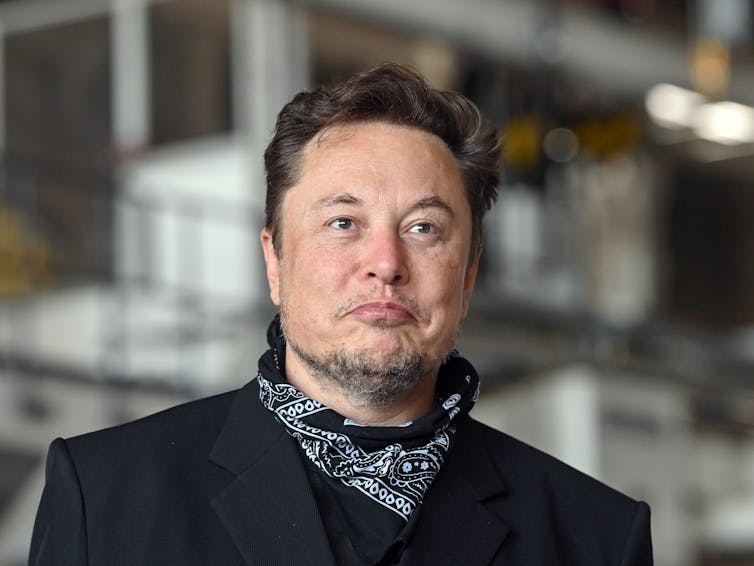
Elon Musk has tried to generate revenue by charging users of the site. Naga11 / Shutterstock
Twitter’s price tag drove Musk to make major instant changes. He scythed through the workforce, reducing the 8,500 employees to 1,500 in a matter of weeks. Charging users alienated many. Many of the advertisers on Twitter viewed Musk and his forthright views as toxic to their own image and not something they wanted to be associated with through advertising.
Many left or suspended their advertising activities with Twitter. Twitter had become synonymous with Musk and not everyone loved him. He had reduced the cost base but lost much of the revenue. Realising that he needed to start distancing himself from Twitter for the good of the company, he recruited Linda Yaccarino from Xerox as chief executive while he stepped back to be chairman.
Linda has enormous experience in advertising and was clearly charged with rebuilding relationships with advertisers. However, she may find her remit limited by a chairman who may want to intervene.
Strategic mistake?
However, Musk may also have been guilty of strategic mistakes: if a company relies on advertising for revenue, then it needs to maximise users to create advertising reach. Charging Tweeters and those reading Tweets is not going to maximise users, because many of them may simply leave. Charging both advertisers and users makes little limited sense.
The timing for introducing subscriptions is also wrong. Many countries in which Twitter operates are approaching recession. Subscriptions for content are being ended by many users, who are being forced to cut back as their disposable wealth is squeezed. They are likely to take a dim view of Twitter introducing new charges for a service they are used to receiving for free, or at least just paying with their data.
While Twitter was undoubtedly heavy on cost before Musk took over, the extent of the staff cuts has left content frequently unmoderated. Also, problems are brewing with regulatory authorities around the speed of removal of controversial material that appears on Twitter. Strong rumours of unpaid bills are also following Twitter about.
Against this background, and Twitter’s apparent self-destruction, Mark Zuckerberg has picked just the right time to offer a well-funded alternative linked to Instagram. As far as we are aware, it will be free to users and funded by advertising once it has adequate usage.
There is no love lost between Zuckerberg and Musk. Meta picked the right time to launch while Twitter was at its weakest and Musk was torn between conflicting needs at Tesla and Twitter. Musk’s hobby is turning into an albatross. Zuckerberg will make progress despite the strong position Twitter occupies and the relationship with Instagram may help drive network effects. Network effects form barriers to new entrants to a market in that the more suppliers joining up, the more users are attracted and vice versa.
Zuckerberg needs to entice big-name Threaders to offer their views in succinct form onto his platform to attract users. This in turn should attract more big names. Dominant businesses that rely on network effects are difficult to unseat due to the dependent relationship between users and providers.
Musk is now attempting to sue Meta for misappropriating trade secrets, as unsurprisingly they recruited many of the people sacked by Musk at Twitter. Litigation is often used as a weapon in US competition.
Will we end up with a polarised audience where those of a liberal disposition favour Threads, while those with more right-wing sympathies use Twitter? Unlike the proposed cage fight between Zuckerberg and Musk, this clash of social media companies can’t be settled by a simple knockout.







