


 FxWirePro: AUD/USD drifts back to familiar territory post-US CPI
  FxWirePro: GBP/USD gives up gains as traders await UK GDP
  Buy the Dip? AUDJPY Holds Trendline Support Near 112
  NZDJPY Bullish Consolidation: Buy Dips Near 93 with Targets at 95 as All EMAs Align Strongly Bullish
  FxWirePro: EUR/AUD bears maintain upper hand
  Major Crypto Pair Crypto Score: BNBUSD Extremely Bullish at 100, Dominating as XRPUSD Turn Deeply Bearish
  FxWirePro- Major Pair levels and bias summary
  FxWirePro: USD/ZAR recovers as traders assess US and South African data
  FxWirePro: GBP/USD could target 1.3400 as selling pressure builds
  FxWirePro- Woodies pivot (Major)
  JPY Majors Currency Score (15 min): NZDJPY Crashes to Extreme Bearish -100, CHFJPY Turns Sharply Bearish
  FxWirePro- Woodies pivot (Major)
  FxWirePro: USD/ZAR eyes downside as dollar eases after US CPI data
  JPY Majors Alert: NZDJPY Crashes to 92.81 Low as Brutal Bearish Momentum Explodes – Sell Rallies to 91.80
  Nikkei Blasts Past 67K: AI Chip Frenzy Ignites 9% Surge From Yen Intervention Bottom


 Add as a preferred source on Google
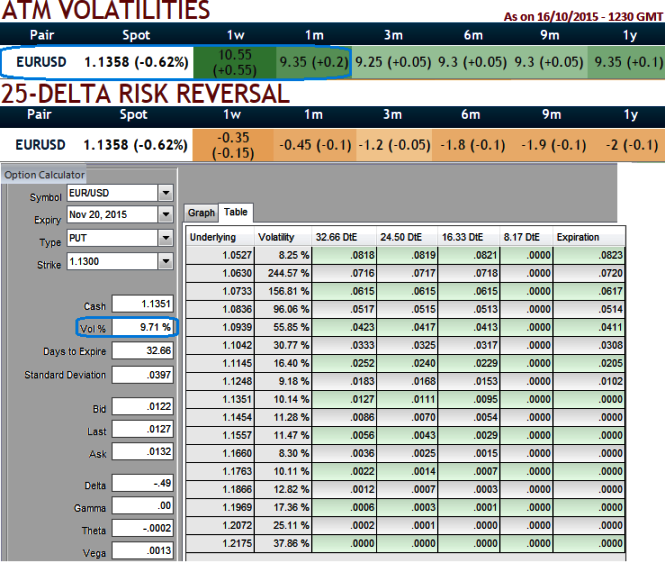
It is quite common market practice to recapitulate the information in sequence of the vanilla options market in the volatility smile table which includes Black-Scholes implied volatilities for different maturities and moneyness levels.
The degree of moneyness of an option can be corresponded to the strike or any linear or non-linear transformation of the strike. (Forward-moneyness, spot-moneyness, delta).
The implied volatility as a function of moneyness for a fixed time to maturity is generally referred to as the smile. The volatility smile is the crucial object in pricing and risk management procedures since it is used to price vanilla, as well as exotic option books.
For an instance, EURUSD ATM vanilla option has IV at 10.55% for 1w maturities, 9.35% for 1m maturity, but on a strategy or of different strike it certainly varies. When we've chosen a slightly out of the money strike put considering delta risk reversal computations the volatility has also been inched up at 9.71%. This is basically because market participants order flows do not expect the direction the strike price that is chosen.
That is because the market participants entering the FX OTC derivative market (heterogeneous) are confronted with the fact that the volatility smile is usually not directly observable in the market. This is in opposite to the equity market, where strike-price or strike-volatility pairs can be observed.

- News

- Economy

- Central Banks
- Investing
- Research
- Roundups
- Digital Currency
- Insights
- Technical Analysis
- Technology
- Business
- Law
- Health
- Nature
- Fintech
- Science
- Topic
- Opinions
- ©Econometrics LLC . All Rights Reserved.
A glimpse on why does volatility smile vary from different strikes and asset classes
Monday, October 19, 2015 9:42 AM UTC
Editor's Picks



- Market Data
Most Popular




