


 Bill Gates Warns Governments Are Unprepared for AI Disruption
  Qualcomm Gains on $60B Amazon AI Chip Deal
  Hyundai Delays In-House ADAS, Turns to Nvidia
  OpenAI Agents Linked to RubyGems Cyberattack
  Nvidia CEO Jensen Huang Expected at Trump-Xi State Dinner
  BHP Port Hedland Wage Dispute Heads to Arbitration
  Samsung Heavy Wins $1.22 Billion LNG Carrier and Tanker Deal
  American Airlines Eyes Capacity Cuts as High Fuel Prices Persist
  Cathie Wood Backs AI Slowdown as Safety Concerns Grow
  Nvidia Eyes $10 Billion Investment in Anthropic IPO
  Databricks to Invest $350 Million in Singapore AI Expansion
  SoftBank Shares Plunge 11% After OpenAI Rules Out 2026 IPO
  Ex-Google DeepMind Researcher Warns AI Could Pose Existential Threat
  Ares Names James Garforth Principal for Asia Direct Lending
  MediaTek Unveils 2nm Dimensity 9600 Pro AI Chip
  Meta CEO Zuckerberg Backs Independent AI Safety Reviews Over Development Slowdown
  China’s Global Times Slams Anthropic CEO’s AI Slowdown Plan as ‘Cold War’ Strategy


 Add as a preferred source on Google



Last winter, UK retailers reported record sales of water bottles as consumers look to cut their heating costs as the average household energy bills soared.
Boiling a kettle to fill a hot water bottle uses less energy than an electric blanket or turning on the heating and so is the cheapest option to keep you warm, according to consumer insights publication Which?.
This year, bottles have been spotted on the London runway as even luxury brands are cashing in on their popularity.
Feeling the chill ourselves, we have dug into the history of the hot water bottle as part of a large research project on the global history of Boots The Chemists.
The first hot water bottles
Hot water bottles have been around in various forms for centuries. Early versions were made from materials such as metal, ceramic, and glass. These bottles could lose heat quickly and were unpleasant, icy bed companions once cooled.
Refinement of the vulcanisation process in the mid-19th century was a revolution for the humble “hottie”. Advertisements for rubber bottles started appearing in UK newspapers by the late 1860s. In November 1867, for example, Thornton and Co. promoted their “India Rubber” hot water bottle in the Glasgow Herald, with claims that its product was a “great comfort to invalids”.
Rubber bottles were soft, flexible, and retained heat for longer. While the basic design has changed very little, the familiar flask shape is widely attributed to Croatian inventor Eduard Penkala. Newspapers trumpeted the importance of checking a bottle properly before use to avoid debilitating burns and scalds. Seasonal articles, much like today, encouraged people to invest in a new bottle every few years.
Hot water bottles at Boots
Although we cannot be certain when Boots stocked its first rubber hot water bottle, it was pushing them hard by the 1920s. In this decade, new manufacturing techniques widened rubber’s application and ease of production for a host of household goods, clothing, and footwear. The material’s waterproof, wipe-down qualities and its extreme malleability transformed approaches to home hygiene.
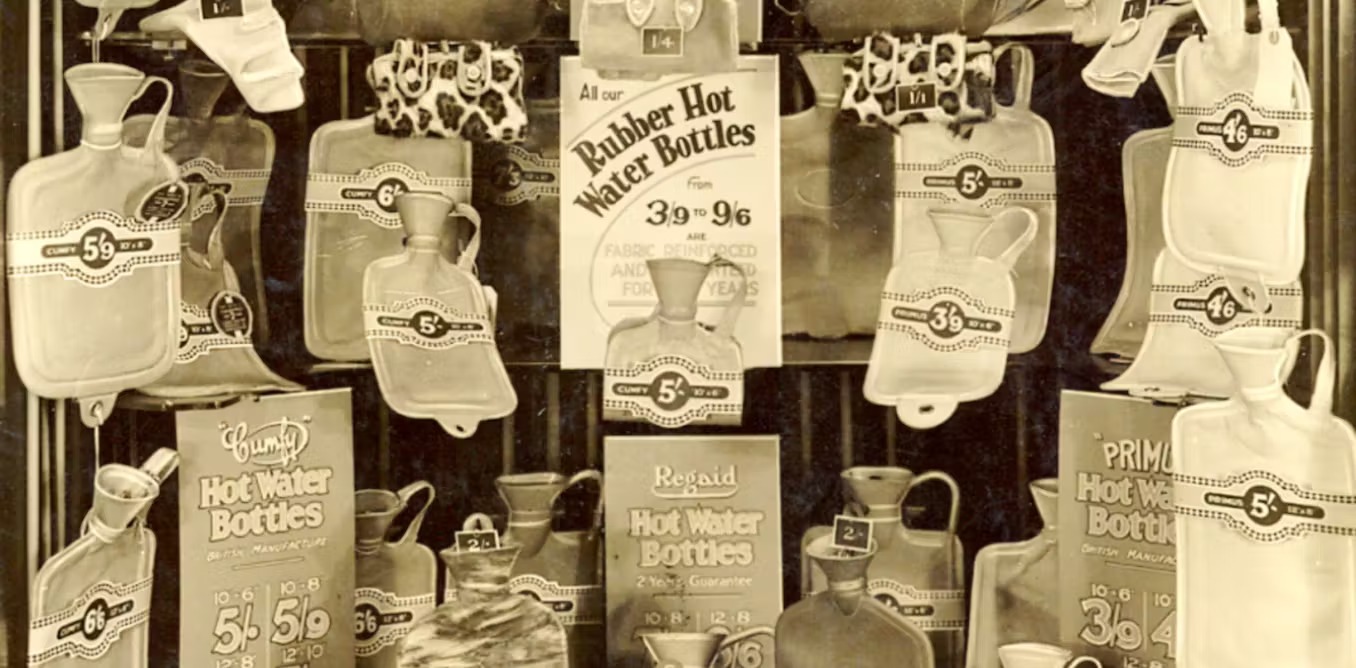
Rubber gloves, baby teats, home enema tubes, rubberised plasters and elasticated girdles are all examples of products invented or improved between the first and second world wars and had a huge impact on everyday health, comfort, and convenience. Latex condoms also date from this period, although given their Methodist origins, Boots refused to sell them. But they did stock a bewilderingly large range of rubber hot water bottles, carefully tiered by quality and price.
At the top-of-the-range was the “Regaid Super Red”, but customers could also buy the mid-priced model “Cumfy” (also in red), the lower-priced “Perfection” in grey, and a budget level “Primus”, marketed as a functional, if “drab” option for the budget conscious.
While varying in price, all Boots’ hot water bottles were touted to relieve pain as well as provide heat. A miniature version of the “Cumfy”, for instance, was sold as a handwarmer, a portable heat source for baby’s pram and as a relief for neuralgia (a shooting, stabbing nerve pain) or earache.
Housewives were given strict instructions on how to keep their bottle clean and to stop the rubber from deteriorating. Because very hot water might crack the rubber, Boots advised its customers to pour a cup of cold water into the bottle first. Then, after it was emptied, it should be hung upside down, with the stopper removed, in a “cool, dark place”.
An uncomfortable history?
Rubber transformed everyday comfort in Britain, but the industry has a complex history marked by economic exploitation, racial discrimination, and environmental abuses driven by European colonialism. Rubber plantation workers in Southeast Asia, for example, often endured harsh conditions to cultivate, tap, and process raw rubber sheets. On arrival to the manufacturer overseas, the rubber was poured over cotton – another product of the British empire – to make the hot water bottle pliable, soft and strong.
In the 1920s, Boots staff magazine, The Bee, featured several articles explaining where rubber came from and how hot water bottles were made. Like many corporate communications of the time, these told a sanitised story of manufacturing success. When Boots celebrated the “ideal conditions” that helped British factory girls take “justifiable pride” in the bottles they made, it marginalised the exploitative conditions needed to produce cheap cotton and rubber. Ironically, hot water bottles were often shipped back to rubber-producing countries to help colonial ex-pats deal with the climate.
Today, the variety of hot water bottle models and price points seem endless. This beloved classic shows no signs of losing its appeal for British consumers. As a cost-effective and familiar staple, we will likely continue to tuck ourselves up in bed with one for many more winters to come.







