


 fnny Beta Launches With a Simple Idea: Find an Event, Show Up, Get Rewarded
  Hawkish Fed Fuels Gold Sell-off: Gold Dives Below $4300 Amidst Rate Hike Fears


 Add as a preferred source on Google
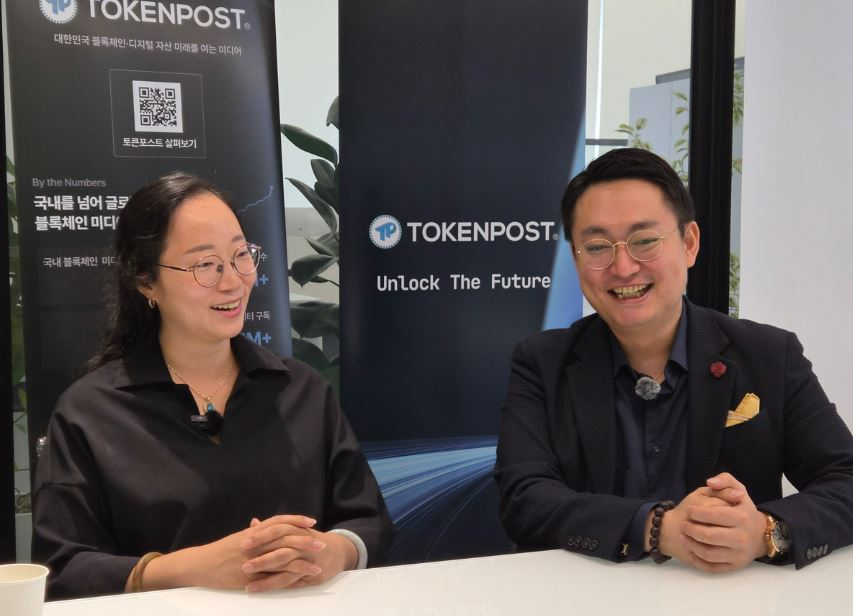

Kkikdageo(끽다거·喫茶去)'s vault holds what it says is the world's largest trove of aged pu'er — 120,000 cakes that survived the Cultural Revolution. Its first tokenized batch just went live on a trading platform handling more than $7 billion a year.
The most valuable thing in Ahn Sung-hee's family business is not for sale, and for most of its life nobody wanted it anyway.
It sits in four climate-controlled warehouses in Seoul: roughly 120,000 cakes of fermented pu'er tea, 119 distinct varietals, none younger than three decades. Some of it predates the Cultural Revolution. The family that owns it — through a tea house called Kkikdageo — believes it is the largest single-owner collection of aged pu'er in the world. By their accounting, even China's most aggressive private collectors hold a few hundred cakes, perhaps a few thousand if you count 1990s production.

For thirty-four years the inventory mostly just aged in the dark, a slow-moving asset in a market with no auditor, no public price, and no clean record of who owned what. Now Ahn and her husband, Son Sung-hoon, are trying to drag that opaque, cash-and-handshake world onto a blockchain — and in late June they put their first batch on the rails, listing a 1989 vintage as a digital redemption product on SwitchWon, a global asset-trading platform that the company says clears more than 10 trillion won, or about $7.3 billion, in annual volume.
It is, the couple argues, the first time aged pu'er has ever been structured as a real-world asset (RWA) token. To understand why anyone would tokenize tea, you have to start with a counterintuitive fact about where the old, valuable stuff actually is.
The tea that left China
The common assumption is that the oldest and best pu'er must be in China. The opposite is true.
"When China went communist in the 1950s, anything that could be sold was exported," Ahn said. "Pu'er left the country in that process — to Hong Kong, Taiwan, Japan, Southeast Asia."
In Hong Kong, the bulk buyers turned out to be large restaurants. Unlike oolong or green tea, which must be re-leafed for each pot, pu'er holds its flavor even as fresh leaves are topped up — a labor savings that made it the house tea of choice. Restaurants stockpiled it in basements. Years later, as those businesses wound down, the storerooms were often handed wholesale to the caretakers who ran them. When those caretakers aged and went to settle their estates, they found mountains of what looked like anonymous "black cakes," and started carrying samples to tea shops to ask what they had. That is how a generation of dormant aged tea — lao cha — re-entered the market.
Ahn's father sat at the center of that network. He spent twelve years studying in Taiwan, building relationships with tea-house owners, and learned pu'er from a professor he met while studying tai chi — a man later regarded as a founding master of pu'er connoisseurship. The reference guide that professor published in the 1990s, cataloguing what was produced from the 1910s through the 1990s, still functions as the market's genealogy. A cake that doesn't appear in it is a cake whose authenticity can't be vouched for.
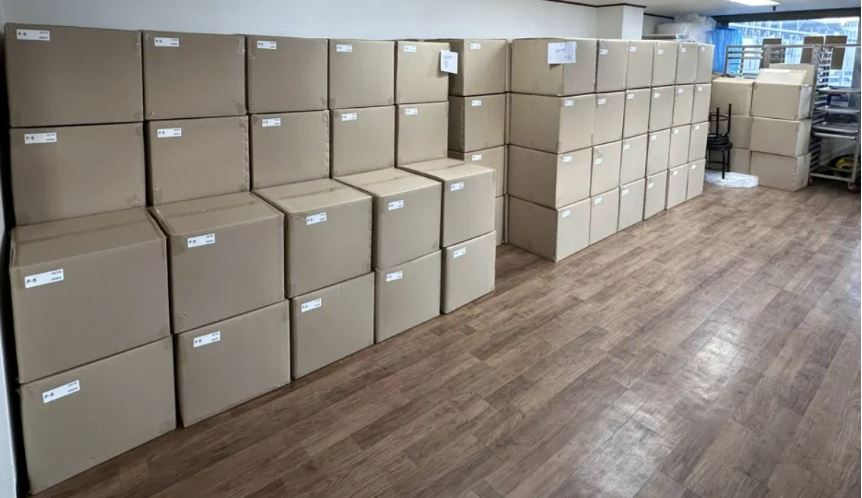
From a six-square-foot tasting room
Ahn's parents came home to Korea in 1992 with a conviction: that Koreans, who had been a tea-drinking people since the Silla dynasty, had simply lost the habit through colonization and war. "People don't drink it because they've never tried it," was the operating premise. They opened in a roughly six-square-foot space near Jogyesa Temple in central Seoul and gave the tea away — free tastings, no age or status filter, a room so small that the owner and a single guest filled it.
The name they chose, Kkikdageo, comes from a Zen koan attributed to the Tang-dynasty master Zhaozhou: roughly, "have a cup of tea and go." The character kkik implies not just drinking but savoring.
Ahn — born in Taiwan, brought to Korea at nine — grew up inside the business and laid claim to it early. She gave up an art track abroad, came home to work the shop floor, took a graduate degree in Eastern philosophy, and spent a year studying the Japanese tea ceremony, on the theory that she needed to understand the tea cultures of China, Korea and Japan all at once.
"They only showed me the vault after we registered the marriage"
Son's entry into the family reads like a setup for a heist. He'd come out of IT, moved into China-facing distribution, and ran into a wall: you cannot do business with Chinese counterparts if you don't understand tea. He went to learn it — at Kkikdageo, where he completed the father's year-long tea course as a formal student. Then he married the founder's daughter.
"It was only after we got married and registered it legally that he finally took me to the warehouse," Son said. It was a space no one outside the family knew about. "I was overwhelmed the moment I saw it. I'm someone who knows exactly how the Chinese think about aged pu'er. The quantity made no physical sense. I asked how much was there, and they said they didn't know."
His first move was an engineer's move: count it. Under a non-disclosure agreement, he brought in an outside tax-accounting firm, and over several months its staff and the family went warehouse to warehouse, pulling tea out of jars as tall as a person, counting it, and putting it back. His in-laws had guessed 30,000 to 40,000 cakes. The audited figure came back at 119 varietals and roughly 120,000 cakes — counting only genuine raw tea over thirty years old.
Why 99% of pu'er never appreciates
Son treats the market like a system to be reverse-engineered. "Why do only some pu'ers go up? When I checked, the teas that appreciate and the teas that don't were clearly separable."
His criteria, distilled:
It has to be wild tree. Only leaves from the tall old-growth tea trees — 15 to 17 meters — that grow wild in Yunnan carry value; manicured waist-high plantation bushes don't. The oldest known specimen, a roughly 3,700-year-old "tea king tree," has had 2 kilograms of its leaf trade for around 2.6 billion won (about $1.9 million).
It has to be raw (sheng), not ripe (shou). Ripe pu'er is force-fermented and tastes essentially fixed from day one; raw pu'er post-ferments over decades and changes dramatically. "Raw pu'er is a Michelin restaurant. Ripe pu'er is a microwave meal."
It has to be at least 30 years naturally fermented, and it has to appear in the genealogy — the documented provenance.
Storage decides the rest. Excess humidity makes a cake shed crumbs and lose mass. For a cake originally pressed at 357 grams, whether it still clears 300 grams can swing the price enormously: on a 1950s "Red Mark" (hongyin), Son said, a two-gram difference can mean a gap of 50 million won — about $36,000.
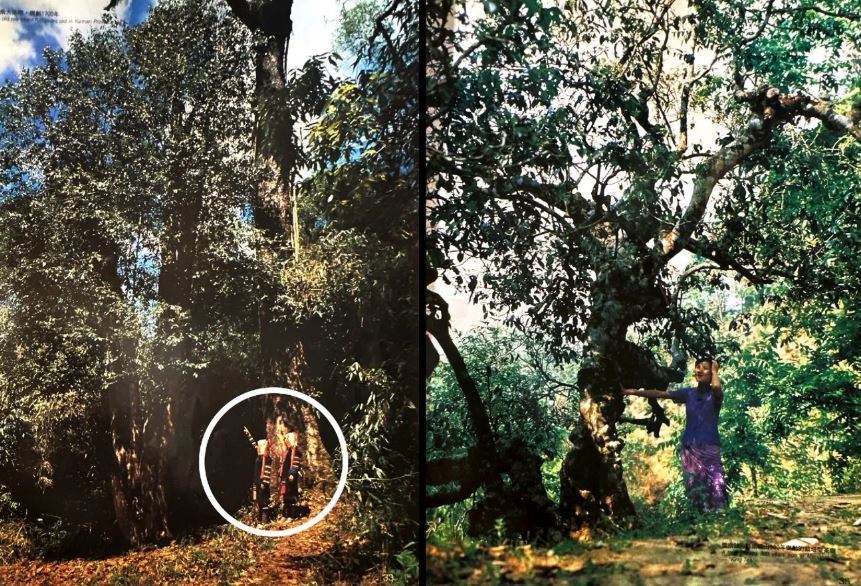
The striking part is what doesn't exist: an authenticator. Asked whether any official body certifies those five conditions, Son was blunt. "There isn't one. We commissioned Yunnan's top state-level appraisal institute, and the answer came back that teas made before 2000 can't be appraised — there's no database." A tea the mainland itself can't authenticate. And yet, he and Hong Kong auction specialists say, an experienced taster can judge authenticity better than 70% of the time by aroma and flavor alone. At Hong Kong auctions, cracking the wrapper to smell the leaf is often enough to separate real from fake. "With wine you have to open the bottle to know its condition. With pu'er, a single fallen crumb tells you."
A market drinking itself dry
The size of the aged-raw market is best read off Hong Kong's auction houses. A single specialist house moves roughly 180 billion won — about $130 million — across four public sales a year, with private monthly sales on top. Once an auction sets a price, the retail market follows it.
Supply can only shrink, because — unlike paintings — pu'er is consumed. Into the early 2010s, the top auction lot was always haoji tea, made by pre-communist family houses. As haoji vanished "like unicorns," 1950s–60s yinji (state-factory) tea took the top slot — graded by the color of the mark stamped on the highest grade: red, then blue, then yellow. A single 1950 Red Mark cake now runs from about 150 million won to 300–400 million won — roughly $110,000 to $290,000 — depending on storage.
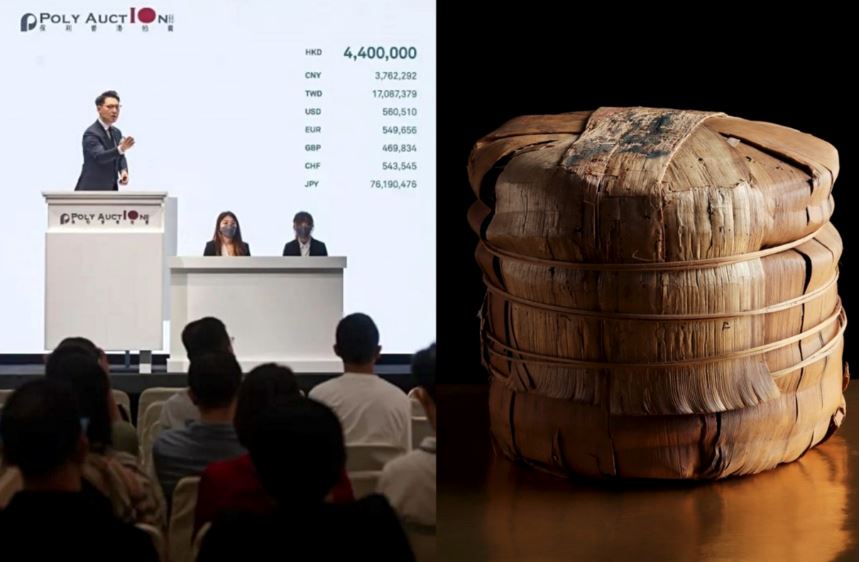
The pandemic was the accelerant: as papers circulated in mainland China claiming tea helped against Covid, Chinese-world collectors drank down their holdings. "From 2021, for the first time, 1980s tea started showing up as the top lot. Now '90s tea is the third or fourth lot. That tells you the market is running dry." Five leftover broken pieces of old yinji, he noted, can now open bidding at 20 million won — about $14,500.
A 120,000-cake hoard, a vanishing supply, a market with no authenticator. That gap is where Son, the IT guy, landed on his conclusion: to pull this gray market into the light, you put authentication and transaction records on a blockchain.
Part II — The listing: NFTs as bottle-stamps, and a vault the family is in no rush to sell







