


 Gold Prices Fall Amid Rate Jitters; Copper Steady as China Stimulus Eyed
  U.S. 10-Year Treasury Yield Hits 2007 High as Fed Rate Hike Bets Rise
  Australia Unemployment Hits Five-Year High Despite Strong Jobs Growth
  Gold Prices Fall as Treasury Yields Rise on Fed Rate Hike Bets
  Best Gold Stocks to Buy Now: AABB, GOLD, GDX
  Fed Unveils Stablecoin Rules Under GENIUS Act
  Oil Prices Jump 3% as Houthi Attack Revives Supply Fears
  US Stock Futures Fall as Treasury Yields Surge Ahead of Trump-Xi Summit
  Asian Currencies Mixed as Dollar Holds Near Two-Month High
  Fed Unveils Stablecoin Rules Under GENIUS Act
  RBI Uses $10 Billion Currency Swaps to Drain Excess Rupee Liquidity
  Dollar Hits Two-Month High as Fed Rate Hike Bets Rise


 Add as a preferred source on Google
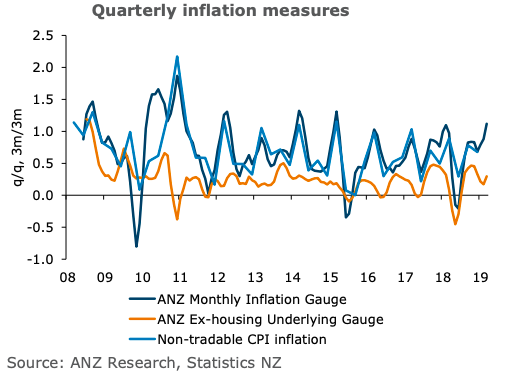
New Zealand’s ANZ Monthly Inflation Gauge dipped 0.1 percent m/m in March, but strength in the early months of the year took the quarterly increase to 1.1 percent for Q1. The Gauge has given a very accurate read on non-tradable inflation in the last two CPI prints.
Overall, 10 of the 36 subcomponents rose in March, while 6 subcomponents fell. Housing-related prices were strong in the month, with rents, purchase of housing, and property maintenance services among the top contributors. On the downside, telecommunications and accommodation services were a drag.
On a quarterly basis, strength was driven by prices for tobacco and cigarettes, rents, domestic airfares, and medical services. The regulated increase in tobacco products in Q1 contributed around half the quarterly print (0.52 percentage point), while domestic air transport contributed 0.12 percentage point. Airfare prices have been volatile, and strength in Q1 comes after a sharp drop in the December month.
As a result, the increase in airfare prices in the Gauge was stronger than usual for a March quarter. Annual growth rose to 2.4 percent, towards a level more consistent with Statistics NZ’s annual non-tradable numbers. Excluding housing-related prices, the Gauge fell 0.2 percent m/m, pushing annual growth up to 0.8 percent from 0.5 percent.
"Waning momentum in the economy means inflation pressures will soon fade. However, we could see some further strength in annual non-tradable inflation in the short term as a result of the previous build-up in capacity pressures," ANZ Research commented in its latest report.







