


 Bitcoin Tests Crucial $82K Support as $90K Breakout Looms
  Geopolitical Shocks That Could Reshape Financial Markets in 2025
  Mexico's Undervalued Equity Market Offers Long-Term Investment Potential
  Standard Chartered Sees Ethena ENA Hitting $2 by 2028
  U.S. Treasury Yields Expected to Decline Amid Cooling Economic Pressures
  RBI Uses $10 Billion Currency Swaps to Drain Excess Rupee Liquidity
  STX.CITY Melts the Charts": Crypto Category Heat Map Shows Bitcoin L2 Mania Leading the Pack
  Cardano Price Struggles as NIGHT Token Surges 20%
  China's Refining Industry Faces Major Shakeup Amid Challenges
  ECB May Stop Rate Hikes After December, Capital Economics Says
  BOJ Set for 25-Basis-Point Rate Hike as Yen Weakness Fuels Inflation
  Yen Sinks as BOJ Rate Hike Fails to Impress Markets
  Morgan Stanley Launches Digital Asset Lab for Stablecoins and Tokenization
  Hyperliquid Sets $856 Million HYPE Token Unlock for October


 Add as a preferred source on Google
In this write-up, we run you through the DBS bank’s perceptive views on rate yields outlook in one emerging market in comparison with USTs.
The Central Bank of Malaysia maintained the status quo in its monetary policy, keeping benchmark interest rate unchanged at 3.25 percent on January 24th, 2019, as widely expected. Policymakers that the decision in consistent with the intended policy stance and they will continue to monitor the balance of risks surrounding the inflation and domestic growth outlook. The Committee also noted that the economy maintains its underlying fundamental strength, with steady economic growth, low unemployment, and a current account surplus.
Well, with growth outlook biased to the downside and inflationary pressures likely to stay benign, we expect Bank Negara Malaysia (BNM) to keep policy rates unchanged today (decision expected today at 3pm) and rest of the year. IRS markets are largely in line though pricing has recently moved from small chance of 1 hike to small chance of 1 cut.
Based on several valuation metrics, Malaysian Government Securities (MGS) look cheap. Real yields on 10Y bonds are elevated at 4.0% vs the long-term range of 1.0 - 2.5%. 10Y spread over US Treasury has surged to 130bps, high compared to other similarly-rated sovereign credits such as Poland (11bps) and Thailand (-30bps).
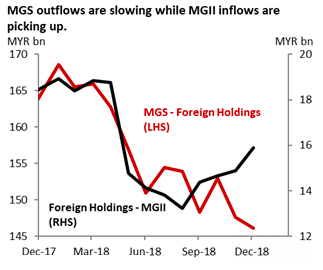
We recognize that some of the cheapness should be attributed to weaker fundamentals. Malaysia's fiscal position has worsened post-elections and reforms could take some years to complete. However, in our view, the government’s reform plans are credible and the risk of rating downgrades remains low (Moody’s recently reaffirmed Malaysia’s rating at "A3" and kept outlook "stable"). Looking at technicals, the pace of outflows from MGSs is slowing and Malaysia Government Investment Issues (MGII) are seeing healthy inflows lately. Positioning is probably light after 2018’s outflows and we could see some yield compression when inflows return. All considered MGSs are cheap even after accounting for the weaker fundamentals.
On a currency-hedged basis, MGS yields have turned very attractive. MGS-UST yield differentials have widened and the cost of hedging has declined. Courtesy: DBS & Bloomberg
Currency Strength Index: FxWirePro's hourly USD spot index is inching towards -73 levels (which is bearish) while articulating (at 10:30 GMT).
For more details on the index, please refer below weblink: http://www.fxwirepro.com/currencyindex







