


 Bitwise Launches NEAR ETF as $562 Bull Case Fuels AI Crypto Buzz
  Yen Sinks as BOJ Rate Hike Fails to Impress Markets
  Bitcoin Tests Crucial $82K Support as $90K Breakout Looms
  STX.CITY Melts the Charts": Crypto Category Heat Map Shows Bitcoin L2 Mania Leading the Pack
  QNT Whales Move $10M to Exchanges After 400% Rally
  Gold Prices Slide as Rate Cut Prospects Diminish; Copper Gains on China Stimulus Hopes
  Bank of America Posts Strong Q4 2024 Results, Shares Rise
  Oil Prices Dip Slightly Amid Focus on Russian Sanctions and U.S. Inflation Data
  RBA Says ASX Still Falls Short on Governance and Risk Controls
  Bitcoin Short Squeeze Wipes Out $259 Million After U.S. PCE Data
  Central Banks Could Buy 20,000 Tonnes of Gold: BofA
  Gold Prices Fall Amid Rate Jitters; Copper Steady as China Stimulus Eyed
  Moody's Upgrades Argentina's Credit Rating Amid Economic Reforms
  Geopolitical Shocks That Could Reshape Financial Markets in 2025


 Add as a preferred source on Google
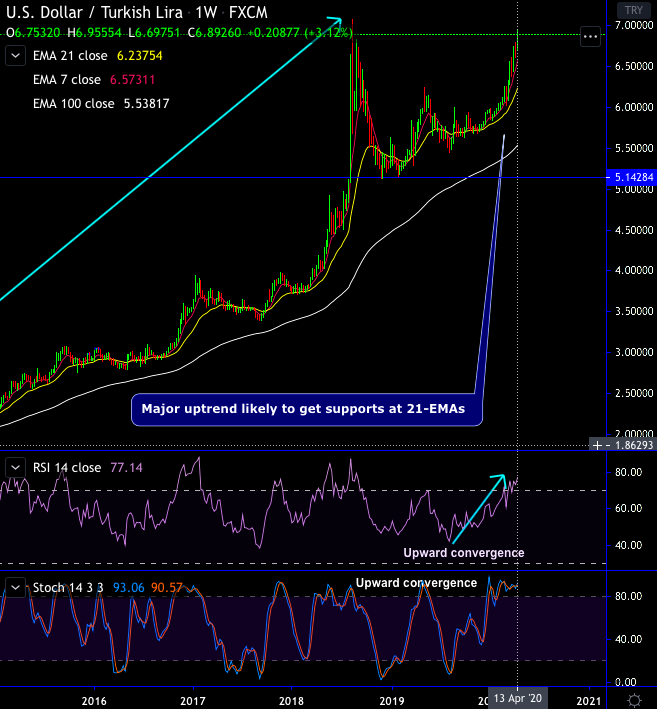
USDTRY has been edging ever closer to the 7.00 mark as predicted in our recent post despite the central bank combatting the trend using indirect FX interventions. CBT’s own FX reserves have fallen to a low c.$27bn in net terms (excluding banks’ FX RRR). This miniscule reserve, compared with c.$162bn of foreign debt rollover requirement for 2020, means that the supply of dollars for intervention must come from someplace else – policymakers have reportedly asked state-owned commercial banks to sell their dollars in the FX market – the media reported that state-owned banks sold c.$ 400mn foreign currency yesterday, after selling c.$ 1bn on Wednesday. Whether or not such figures are reliable, there is a high likelihood that we are not seeing the full impact of selling pressure on the currency because policymakers are intervening heavily at the moment. Once resources run out, the situation could quickly escalate.
FX liabilities have become a significant proportion of Turkish GDP because of continuous lira depreciation, which could make it difficult to service external liabilities. This is the market’s main concern. And even if policymakers can’t be blamed for the economic downturn, a botched policy response at this time could turn the situation into an unnecessary crisis. Trying to stem lira depreciation by FX intervention from a limited FX reserve pool, and muddying the waters further by asking commercial banks to sell down their FX balances are rather questionable. Such a strategy can only work if the problem is “very” short-term, lasting only days, no longer. This is not at all guaranteed. Meanwhile, depletion of banks’ FX balances could become the problem itself. Turkish policymakers should urgently change track.
Hedging Strategy:
On hedging grounds, capitalizing on prevailing price dips and above driving forces, we already advocated 2m USDTRY debit call spreads with a view to arresting momentary downside risks and upside risks in the major trend. At spot reference: 6.56 level, initiated 2m 6.25/6.96 call spreads at net debit, it’s been functioning as desired so far. The prevailing spot FX is edging above 6.90 levels, hence, we wish to uphold the same strategy as short leg is still out of the money and one can achieve hedging objective as the deep in the money call option with a very strong delta will move in tandem with the underlying spikes.
It seems that hedgers of TRY are positioned for the upside risks on the above fundamental factors. The skewness of 3m IVs are not stretched on either side, but slightly biased for the upside risks, higher bids for OTM calls are hedging bias towards upside risks (refer above nutshell).
IVs of this underlying pair is also on the higher side, trending highest among the G20 FX space. Call options with a higher IVs cost more, because, increasing IV is conducive for the option holder, just for an intuition that the higher likelihood of the market ‘swinging’ in holder’s favour. Courtesy: Sentry & Commerzbank







