


 China’s Growth Faces Structural Challenges Amid Doubts Over Data
  Energy Sector Outlook 2025: AI's Role and Market Dynamics
  US Gas Market Poised for Supercycle: Bernstein Analysts
  U.S. Banks Report Strong Q4 Profits Amid Investment Banking Surge
  U.S. Stocks vs. Bonds: Are Diverging Valuations Signaling a Shift?
  S&P 500 Relies on Tech for Growth in Q4 2024, Says Barclays
  FxWirePro- Crypto Weekly Alpha: ETF Rebounds, L2 Rallies & Key Resistance Levels
  Who should own the knowledge that underpins AI technology?
  Wall Street Analysts Weigh in on Latest NFP Data
  US Futures Rise as Investors Eye Earnings, Inflation Data, and Wildfire Impacts


 Add as a preferred source on Google
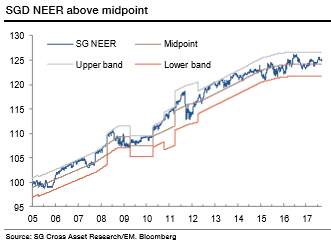
It is believed that SGD would be a regional underperformer and should be used as a funding currency. The chance of the MAS tightening policy is very low and instead we assign a 70% chance that the midpoint of the SGD NEER will need to be re-centered over the coming years.
The economy will likely remain mired in a low growth and low inflation environment due to:
1) The downside risks to Chinese growth in 2018,
2) The weak productivity and slow growth in the labour force,
3) A muted consumer credit cycle,
4) The weakness in property price, and
5) The reduced inflow of foreign labour.
Key drivers: As long as the EUR remains bid, the USDSGD will creep lower. However, assuming the MAS does not tighten in October and Chinese growth starts to slow, the SGD NEER should settle at the bottom of the band.
Risks: Surprise hawkish rhetoric or a tightening of policy (i.e. moving to an upward slope) would shift the SGD’s dynamics to that of an outperformer.
In EM Asia, we hold OW MYR and short USDSGD. Skew: KRW has high skew and high skew-to-vol (call spreads offer attractive discounting for dollar bullish views) – these metrics are very low in SGD and CNH. Convexity: Butterflies are expensive in KRW and cheap in CNH, SGD, TWD, INR, in our view. Use 1m debit put spreads for USDSGD downside risks.







