


 Australia Inflation Cools as Core CPI Misses Forecasts, Easing RBA Rate Hike Pressure
  RBI Holds Repo Rate at 5.25% as Inflation Risks and Global Uncertainty Persist
  Goldman Sachs Names 9 Top Japanese Semiconductor and Electronics Stocks
  Singapore Central Bank’s Exchange Rate Policy Explained: Why MAS Uses the S$NEER Instead of Interest Rates
  Morgan Stanley Sees Fed Holding Rates as U.S. Inflation Cools


 Add as a preferred source on Google
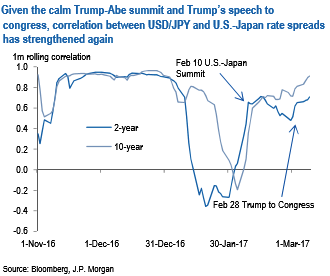
On the macro side, with the chorus of hawkish commentary by the Fed officials, the market has priced in a March hike immediately. Given that, widening U.S.-Japan yield spreads have brought USDJPY higher and the pair is now reaching the upper end of its trading range since mid-January. We now expect the Fed to deliver three hikes in this year (Mar, Jun, and Sep vs. May and Sep previously).
One important assumption of our bearishness on USDJPY is that a correlation between the pair and U.S.-Japan yield spread collapses with heightening concerns on political risks. Although it was the case early this year, the correlation has strengthened again as the U.S.-Japan summit and Trump’s speech to Congress passed without any troubles (refer above chart).
As a more harmonic U.S.-Japan relationship and a more aggressive Fed stance would mitigate downside risks to USDJPY to some extent, we revised USDJPY forecasts for end-June, end-September, and end-year to 111, 108 and 105 from 105, 102 and 99 respectively. We target 105 at end-March next year.
As the new profile suggests, however, we think factors mentioned above would not be influential enough to get USDJPY on a solid upward path heading to 120 or even higher, and still, expect it to track a modest downward trend in the medium-term.







