


 BOJ Raises Interest Rate to 31-Year High as Yen Weakens
  China’s Growth Faces Structural Challenges Amid Doubts Over Data
  Trump’s "Shock and Awe" Agenda: Executive Orders from Day One
  Wall Street Analysts Weigh in on Latest NFP Data
  Yen Sinks as BOJ Rate Hike Fails to Impress Markets
  Global Markets React to Strong U.S. Jobs Data and Rising Yields
  US Gas Market Poised for Supercycle: Bernstein Analysts
  Goldman Predicts 50% Odds of 10% U.S. Tariff on Copper by Q1 Close
  European Stocks Rally on Chinese Growth and Mining Merger Speculation
  Mexico's Undervalued Equity Market Offers Long-Term Investment Potential
  Urban studies: Doing research when every city is different
  U.S. Stocks vs. Bonds: Are Diverging Valuations Signaling a Shift?


 Add as a preferred source on Google
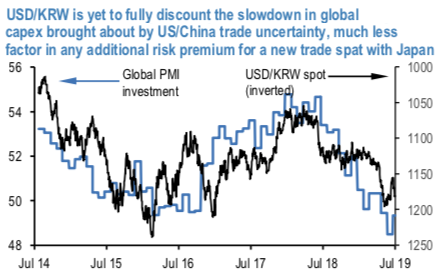
The Asian FX view remains biased in favor of weaker North Asian FX, against the dollar as well as on a relative basis versus less trade-challenged currencies of South Asia. KRW is the poster child for the former, as the won now has to grapple with trade anxieties on two fronts—the long-running US/China feud as well as the more recent outbreak versus Japan.
USDKRW has already undone three-quarters of its pre-G20 decline, but given the currency did not even fully discount, much less build in any risk premium for the global Capex slowdown prior to the eruption of the trade spat with Japan (refer above chart), the path of least resistance for the won is weaker.
Bank of Korea joined the dove camp with a 25bps cut to the policy rates. It makes sense to expect the BOK to remain dovish amid rising uncertainties, which is KRW negative.
Hence, we advocate deploying 3m debit call spreads at net debit using strikes at 1133/1240 levels with a view of arresting upside risks (spot reference: 1175). Thereby, one can achieve hedging objective as the deep in the money call option with a very strong delta will move in tandem with the underlying spikes.
The rationale for the trading: Please observe that the above technical chart is also clearly indicating the further upside risks. Courtesy: JPM







