


 BTC Flat at $89,300 Despite $1.02B ETF Exodus — Buy the Dip Toward $107K?
  FxWirePro- Major Crypto levels and bias summary
  Elon Musk’s Empire: SpaceX, Tesla, and xAI Merger Talks Spark Investor Debate
  JPMorgan Lifts Gold Price Forecast to $6,300 by End-2026 on Strong Central Bank and Investor Demand


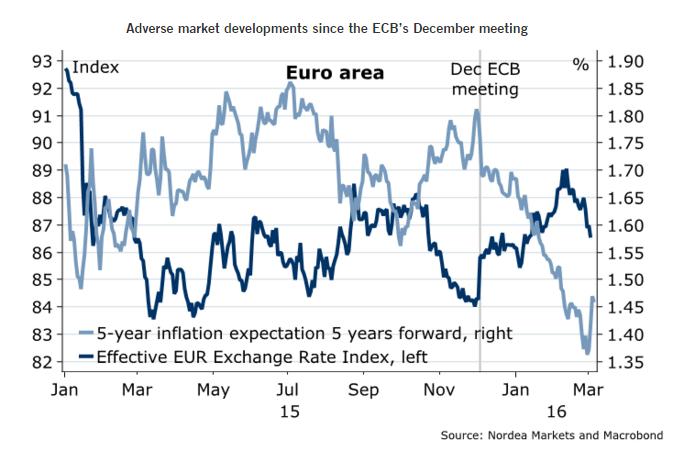
Since the December meeting, eurozone economic outlook and inflation have weakened, leading indicators have fallen short of expectations and global outlook has worsened. The decline in oil prices has resulted in turbulence in financial market which has increased credit spreads and globally worsened financial conditions. Fundamentals definitely support the case of more easing at the ECB meeting on 10 March. More easing from the ECB on 10 March looks virtually certain. Uncertainty remains regarding the measures that will be used.
Draghi will deliver this time, and may not want to repeat the disappointment that took place after the December meeting. The likelihood of a two-tier system has recently increased from the comments by ECB speakers and the recent increase in lending rates in some countries. The ECB is also expected to lower projections for growth and inflation slightly for the coming years. The ECB may loosen or remove the deposit rate floor constraint on the purchases in the public sector purchase programme (PSPP) and further broaden the universe of eligible assets than to remove the capital key or bond specific limits.
"News about ECB deliberations ahead of the policy meeting next week indicate growing concern about pushing rates further into negative territory. The focus might be shifting to asset purchases and implementing a tiered deposit rate on excess reserves. This could just be trying to rearrange the deck chairs, as the impact of unconventional policies fade." notes Societe Generale in a report.
"We expect a steep downward revision of the inflation forecast for this year and for 2017 a rate that is way below the target. Due to the second-round impacts of low oil prices and weakened economic forecast, we expect the inflation forecast for 2018 to still be below the target leaving room for further policy easing." said Nordea bank in a research note.
Markets sceptical about whether the ECB will be sufficiently aggressive to push down the exchange rate, considering the fact that the trade-weighted euro exchange rate has broadly traded sideways since the ECB launched large-scale asset purchases in late January 2015. ING forecast the euro to dollar exchange rate to continue trading within a range of between 1.0800 and 1.0900. More notable losses are however likely against the higher yielders targeted by carry traders in their strategies, including AUD, NZD, ZAR to name but a few. EUR/USD was trading higher on the day at 1.0967 levels at 1000 GMT.

- News

- Economy

- Central Banks
- Investing
- Research
- Roundups
- Digital Currency
- Insights
- Technical Analysis
- Technology
- Business
- Law
- Health
- Nature
- Fintech
- Science
- Topic
- Opinions
- ©Econometrics LLC . All Rights Reserved.
Draghi unlikely to disappoint markets at the March meet despite ECB's past surprises
Friday, March 4, 2016 10:16 AM UTC
Editor's Picks









- Market Data
Most Popular




