


 Europe can’t achieve space sovereignty alone. Here’s why
  Trump Plans Federal AI Force and AI Czar
  Guterres Urges Stronger Global AI Safeguards Ahead of UN Assembly
  Burnham Eyes UK Leadership Role in AI Ahead of Trump Meeting
  Qualcomm Gains on $60B Amazon AI Chip Deal
  SK Hynix, Intel Discuss U.S. Memory Chip Production Deal
  Databricks to Invest $350 Million in Singapore AI Expansion
  SoftBank Launches $11 Billion Bond Sale to Fund OpenAI Investment
  Hyundai CEO Warns Chinese Automakers Could Disrupt US Market
  US Federal Register Drops Alibaba Qwen AI Search Tool
  SpaceX Nasdaq 100 Weight to More Than Double in Rebalance
  Nvidia CEO Jensen Huang Expected at Trump-Xi State Dinner
  Who should own the knowledge that underpins AI technology?
  MediaTek Unveils 2nm Dimensity 9600 Pro AI Chip
  AI is supercharging money scams – here’s what you can do to protect yourself
  NASA, Boeing Discuss Expanding Starliner Missions
  DOJ Will Investigate AI-Related Crimes, Attorney General Blanche Says


 Add as a preferred source on Google
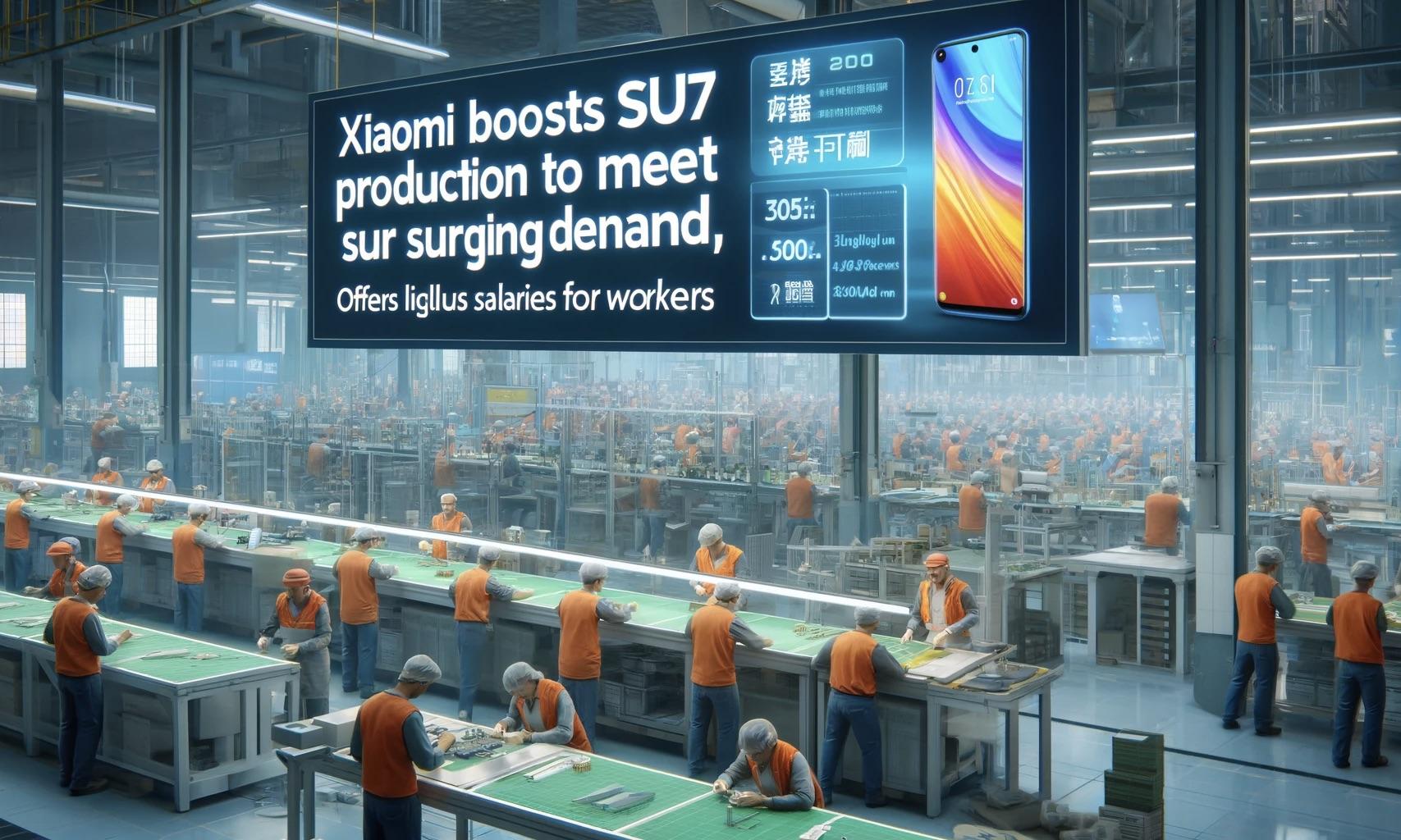
Xiaomi is ramping up production of its SU7 model to meet surging demand, offering competitive salaries and incentives to attract new factory workers and requesting extended hours from current employees.
Xiaomi Increases SU7 Production, Offers Competitive Salaries Amid Rising Demand and Long Wait Times
Demand for Xiaomi's SU7 model is increasing. To accommodate its rapidly expanding order book, Xiaomi is trying to increase production. According to ArenaEV, the company is recruiting new factory workers and offering competitive salaries and incentives. Additionally, it is requesting that current employees extend their working hours.
The Xiaomi EV factory in China seeks to employ a significant number of employees, promising monthly salaries of up to RMB 10,000 (€1,290), which is substantial in the local context. After the year, employees will receive an incentive equivalent to one month's salary.
There are unconfirmed allegations that factory employees work 10-11 hours per day, six days a week. This has prompted apprehensions regarding the working conditions, even though the financial incentives continue to be alluring.
The Xiaomi SU7 was introduced in March and is available in three variants, with a starting price of RMB 215,900 (€27,800). The company established ambitious objectives of 100,000 to 120,000 units annually, with deliveries commencing in April and May. May saw the delivery of 8,646 SU7 EVs, indicating that the company is on course to meet its goal.
However, wait times for specific models presently exceed 30 weeks. Xiaomi management maintains a positive outlook, asserting that the factory will transition to double-shift production this month to deliver a minimum of 10,000 units in June.
Xiaomi Boosts SU7 Production Targets to Meet Soaring Demand, Aims for 10,000 Monthly Deliveries
In last month's report, Xiaomi entered the electric vehicle market with a flourish. The company has increased its production targets in response to the surge in demand for its inaugural model, the SU7.
Xiaomi's initial objective was to distribute 100,000 SU7 units by 2024. Nevertheless, the company has promptly adjusted its aim in response to the resounding reception of this novel electric vehicle. Beginning in June, Xiaomi anticipates delivering a minimum of 10,000 SU7s per month, for a remarkable total of 120,000 units to clients by the end of the year.
The SU7's sales figures indicate its appeal. As of April 30, Xiaomi had received an impressive 88,063 orders, and deliveries in April alone totaled 7,058 units. Xiaomi achieved a significant milestone by delivering its 10,000th SU7 in May, further solidifying its rapidly expanding position in the EV market.
Xiaomi is increasing production to satisfy the growing demand. Beginning in June, the company's Beijing factory will operate on a double-shift model, increasing daily production time from eight to 16 hours. This is anticipated to increase the factory's monthly capacity to nearly 20,000 units.
The SU7's popularity is unsurprising, given its competitive pricing and remarkable specifications. The three versions of the EV are Standard (RMB 215,900 or €27,800), Pro (RMB 245,900 or €32,100), and Max (RMB 299,900 or €39,100). The standard and Max variants were delivered in April, while the Pro version was introduced in early May.
Xiaomi's audacious expansion strategies extend beyond production. By 2024, the company intends to broaden its sales and service network to 219 stores in 46 cities and 143 service centers in 86 cities. This extensive network will ensure that the SU7 is accessible to nearly every province, autonomous region, and municipality in mainland China.
The SU7's success indicates the increasing demand for electric vehicles in China and beyond. Even though Xiaomi only decided to manufacture electric cars three years ago, the company is well on its way to becoming a significant player in the EV market as it increases production and expands its network.







