


 Big AI wants to slow down AI research. Is it a safety pause or a strategic retreat?
  Who should own the knowledge that underpins AI technology?
  Synthetic data could ease people’s concerns about privacy breaches. But who gets to create it?
  Banking scandal rocks Brazil’s politics and the country’s presidential election in October
  Physicists zoom into the birth of cosmic rainstorms with new CERN study
  China’s robots can run faster than Usain Bolt – now they are being prepared for war
  1 in 3 uni students experience serious financial hardship. Could concession cards for all help?
  Europe can’t achieve space sovereignty alone. Here’s why
  AI is supercharging money scams – here’s what you can do to protect yourself


 Add as a preferred source on Google


The Trump administration has just confirmed the appointment of Scott Pruitt, a known climate change denier, as head of the US Environmental Protection Agency.
Elsewhere, in 2014 the government in Sweden misrepresented research on the state of the wolf population to justify hunting them.
And in the United Kingdom in 2006, a parliamentary committee found that the government “twisted” science for political purposes. More recently, Nobel Laureate and Royal Society president Paul Nurse lamented politicians ignoring scientific evidence.
Are we seeing a shift in the way that some politicians use or misuse scientific expertise?
Science has evolved over many centuries to become an integral part of modern society, underpinning our health, wealth, and cultural fabric. Yet scientific evidence is often wilfully disregarded by politicians worldwide.
They often cherrypick or ignore the science when it does not accord with their political agenda. We have seen “alternative facts” supplant scientific and other evidence bases in this “post-fact” era.
While surveys continue to show that the vast majority of people still support and believe in the benefits of science, the recent politicisation of science has at best raised seeds of doubt, and at worst has polarised many people’s worldview.
Perhaps politicians are simply reflecting a tendency for the people to allow their worldview to influence which scientific facts they believe.
Perhaps there is a justification for excluding political appointees to public office who, like Scott Pruitt, are on record for denying the science that is crucial to their decision-making?
After all, while they represent and reflect their electoral peers, politicians have the added responsibility of appointing people who make informed decisions and public policy based on sound evidence.
So it is important now, more than ever, to reinforce with politicians the need to value and respect science in the development of evidenced-based policy.
Science in the house
In Australia, a key connection between science and politics is the annual “Science meets Parliament” event, which began in 1999, and which today is organised by Science and Technology Australia.
This unique event brings together hundreds of scientists and the Australian parliament, and owes its success to the way in which it saturates parliament with science for two days.
There are three key outcomes of Science meets Parliament that highlight its significance:
-
Scientists both young and old convey the excitement and the benefits of science to parliamentarians, thereby helping to close the “virtuous cycle” that supports science in society
-
Scientists, at the same time, develop an appreciation for the process of government, contributing significantly to their professional development
-
Lasting networks are created between parliamentarians and scientists. They go beyond the meetings at Science meets Parliament, and enable scientific engagement with the parliament to extend more broadly, both geographically and throughout scientific and parliamentary careers.
These linkages are the key to ensuring the ongoing contribution of science to government decision making, and thereby to enhancing the role of science in our society.
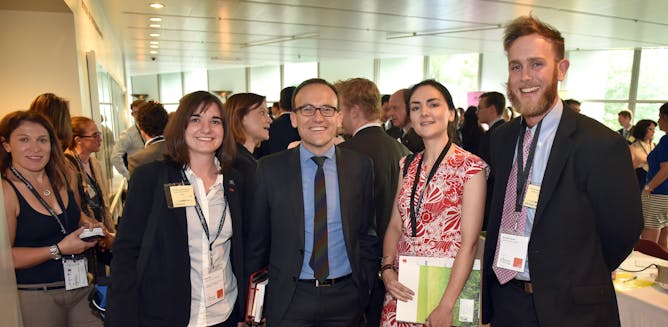
Scientists speaking with Greens MP Adam Bandt. Mark Graham
In science, as in industry, it is also important to innovate continually in our governance processes. Without this, the political system cannot respond to the changing needs of the community. Engagement through events like Science meets Parliament is a key part of that evolution.
Equally, individual scientists need to play a role in everyday life to communicate their science, whether to key decision makers or the wider community, in order to counter “alternative facts”.
In schools, workplaces, community groups and at dinner parties, scientists should convey the consensus view of science even if it lies outside their immediate expertise.
Any scientist with an informed perspective of the state of scientific knowledge on climate change, genetically modified foods, nuclear science or evolution can contribute to enhanced understanding in the wider community.
Whether through Science meets Parliament or as individuals, all scientists have a role to play in countering those who seek to cherrypick and subvert the science that underpins our modern, evidence-based society.
 Ken Baldwin receives funding from the Australian Research Council.







