


 Goldman Sachs Raises USD/JPY Forecast, Sees Yen Weakness Persist Through 2027
  Goldman Sachs Flags 3 Key Risks Ahead of Europe’s Earnings Season
  Asian Currencies Stay Under Pressure as Dollar Holds Near 13-Month High Ahead of U.S. Jobs Report
  Japan Signals Readiness to Act on Yen as Intervention Speculation Grows
  Moody’s Says Peru’s President-Elect Keiko Fujimori Could Boost Investor Confidence
  China Services PMI Beats Forecasts as Strong Demand Supports June Growth
  FxWirePro: Daily Commodity Tracker - 21st March, 2022
  Wall Street Ends Mixed as Weak Jobs Data Lowers Fed Rate Hike Bets, Chip Stocks Tumble


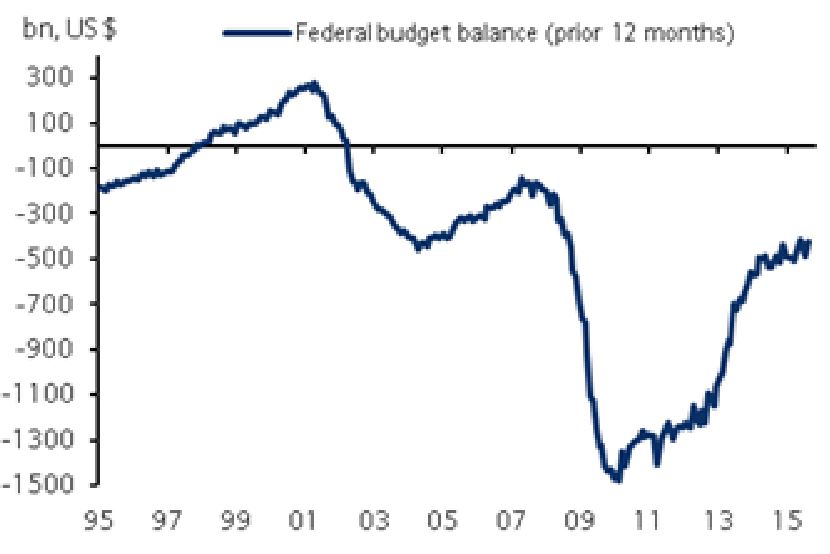
The US federal government reported a monthly deficit of $64.4bn in August, modestly wider than CBO projections ($62bn) and $64bn narrower than in August 2014. A large portion of this decline, however, was due to the time shifting of payments, according to CBO analysis. Adjusting for these calendar effects, the monthly deficit would have narrowed just $4bn from the year prior. Receipts were up 8.5% y/y, driven almost entirely by growth in income and payroll taxes withheld from workers' paychecks. Spending was down 14.8% y/y on a reported basis, but up 4.3% on a CBO calendar-adjusted basis.
The growth in adjusted outlays was driven primarily by mandatory spending on entitlements. Spending on Medicaid, Medicare, and Social Security was up $10bn, while healthcare outlays related to the Affordable Care Act totaled $7bn. A $5bn decline in Department of Defense outlays helped to partially offset this spending growth.
The August data bring the 12-month rolling deficit to $424.2bn, down from $488.4bn last month. Next month's data for September will mark the close of FY 2014. We look for the annual budget deficit to have totaled $425bn, in line with the CBO estimate of $426bn.







