


 Indian Refiners Scale Back Russian Oil Imports as U.S.-India Trade Deal Advances
  FDA Targets Hims & Hers Over $49 Weight-Loss Pill, Raising Legal and Safety Concerns
  Wildfires ignite infection risks, by weakening the body’s immune defences and spreading bugs in smoke
  We combed through old botanical surveys to track how plants on Australia’s islands are changing
  SoftBank Shares Slide After Arm Earnings Miss Fuels Tech Stock Sell-Off
  SpaceX Prioritizes Moon Mission Before Mars as Starship Development Accelerates
  Lake beds are rich environmental records — studying them reveals much about a place’s history
  American Airlines CEO to Meet Pilots Union Amid Storm Response and Financial Concerns
  Once Upon a Farm Raises Nearly $198 Million in IPO, Valued at Over $724 Million
  Missouri Judge Dismisses Lawsuit Challenging Starbucks’ Diversity and Inclusion Policies
  Sony Q3 Profit Jumps on Gaming and Image Sensors, Full-Year Outlook Raised
  American Airlines CEO to Meet Pilots Union Amid Storm Response and Financial Concerns
  Samsung Electronics Shares Jump on HBM4 Mass Production Report
  Fungi are among the planet’s most important organisms — yet they continue to be overlooked in conservation strategies
  DBS Expects Slight Dip in 2026 Net Profit After Q4 Earnings Miss on Lower Interest Margins



Chocolate sales have boomed in recent months. As the cost-of-living crisis bites, consumers are increasingly reaching for chocolate as a simple and affordable pleasure.
The most important ingredient in chocolate is cocoa beans, which come from plants grown in the tropics. About 70% of the world’s cocoa comes from West Africa. The countries of Côte d’Ivoire (Ivory Coast) and Ghana are two of the biggest producers.
Meeting the world’s insatiable appetite for chocolate has wrought a huge environmental cost, as the incredibly rich and diverse rainforests of West Africa are razed to make way for cocoa farms.
Research by my colleagues and me, released today, sheds new light on the problem. By generating a new high-resolution map of cocoa growing areas in Ghana and Côte d’Ivoire, we found the area under cocoa production is truly enormous – and may be associated with up to 37% of forest loss in protected areas.
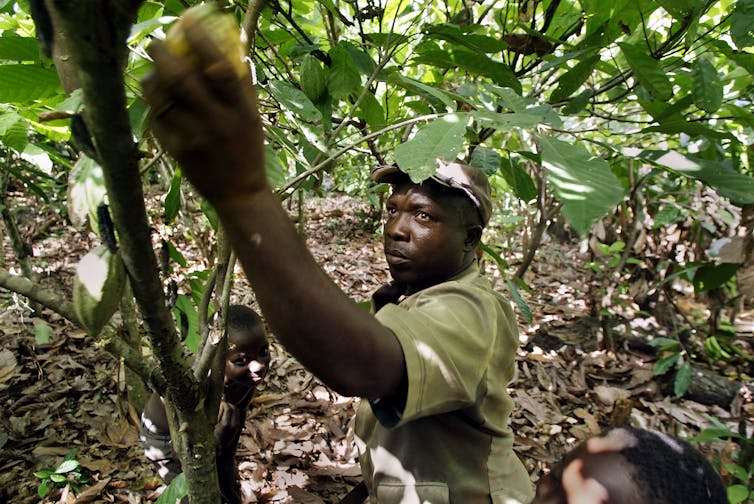
A man picks cocoa pods from a tree on his Côte d’Ivoire farm. Cocoa is a primary driver of deforestation. Ben Curtis, AP
The price of cocoa farming
The Upper Guinean forests of West Africa have been classified as a “global biodiversity hotspot”, due to their exceptional concentrations of plant and animal species found nowhere else on Earth. But much of this forest has now been destroyed.
Since 1950, Côte d’Ivoire has lost up to 90% of its forest cover and Ghana has lost 65%. Cocoa has been a primary driver of this deforestation, together with other crops, mining and logging.
But the exact contribution of cocoa plantations to the problem is not well understood. This is due in part to a lack of an accurate, high-resolution map of cocoa-growing areas.
Without a map, we don’t know where the chocolate we consume comes from. In particular, we don’t know whether the cocoa was grown in formerly forested areas, or even illegally in protected areas.
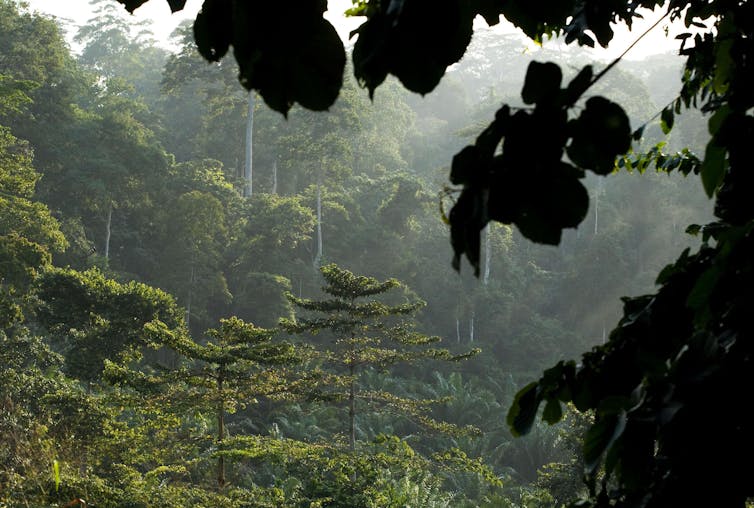
West Africa’s forests have been classified as a global biodiversity hotspot. OLIVIER ASSELIN/AP
What we did
We set out to determine the location and extent of cocoa plantations by using artificial intelligence (AI).
We used a type of AI known as a “neural network”, which allows computers to recognise and predict patterns in data. When a neural network is trained on satellite images showing different land uses, it can apply this “understanding” to identify the same land uses in satellite images of other geographic areas.
In our study, we trained the neural network to recognise cocoa plantations across Côte d’Ivoire and Ghana. We did this using satellite images, together with the known locations of more than 100,000 cocoa farms.
We then checked the accuracy of the information provided by the neural network, by engaging field teams to confirm the results at 2,000 random locations on the ground.
This combination of advanced technology and hard fieldwork allowed us to create the first high-resolution map of cocoa production across West Africa. And what the map tells us is worrying.
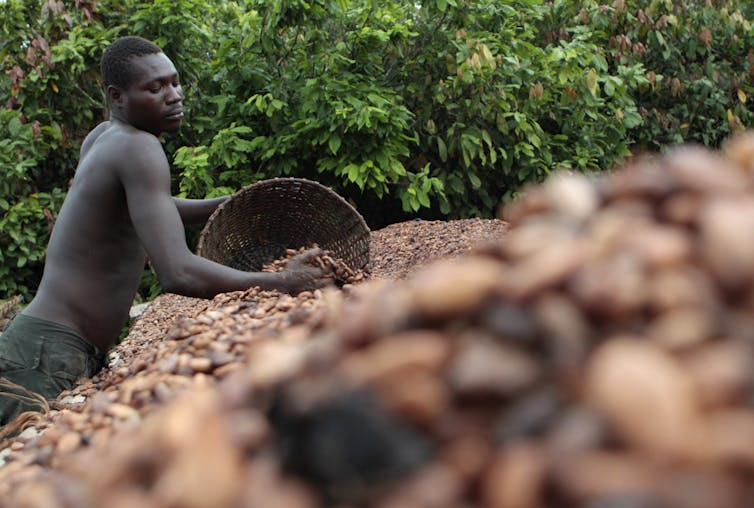
The research set out to determine the extent of cocoa plantations. Rebecca Blackwell/AP
What we found
We found that the land area devoted to cocoa is enormous, comprising more than 7 million hectares of plantations across both countries. The result is far greater than official figures – up to 40% higher in Ghana’s case.
What’s more, much of the cocoa plantation area exists in vast areas of what was once native forest. And more than 1.5 million hectares of land under cocoa production is located in protected areas.
Deforestation in protected areas is a major issue globally. Given where we found cocoa growing, and where forest loss has been observed, we estimate more than 37% of deforestation in protected areas can be linked to cocoa production in Côte d’Ivoire. For Ghana, the figure is 13%.
How do we fix this?
Our map demonstrates the massive role that cocoa may be playing in forest destruction in West Africa, including in protected areas.
This is a complex problem, with no easy fix. Cocoa is grown by an estimated two million mostly small-scale farmers, who typically live below the poverty line on less than US$1 a day. Expanding their cocoa farms into forest is one way farmers and their families can maintain or improve their livelihoods.
To fix this problem, we must help farmers manage existing farms in a more productive and sustainable way. Stronger law enforcement is also needed, to safeguard protected areas. Both will require action from governments and companies.
More money from chocolate sales should end up with the farmer. And consumers may also have to pay more for their chocolate.
Only determined changes on all these fronts will preserve the remaining forests of Côte d’Ivoire and Ghana.













