


 France Urges Faster AI Push Despite Safety Risks
  Novo Nordisk Weighs Direct NYSE Listing to Boost U.S. Profile
  OpenAI Urges US-Led Global Standards for Frontier AI
  Trump Bans CNN, MS NOW and Politico From White House
  Big AI wants to slow down AI research. Is it a safety pause or a strategic retreat?
  Westinghouse Targets $50 Billion Valuation in U.S. IPO
  Hyundai CEO Warns Chinese Automakers Could Disrupt US Market
  Nike Earnings at Risk as UBS Cuts Price Target to $42
  AI is supercharging money scams – here’s what you can do to protect yourself
  US Federal Register Drops Alibaba Qwen AI Search Tool
  Prysmian, Rio Tinto Supply Low-Carbon Cables for Amazon Ohio Data Center
  Volkswagen Shares Slide After 2026 Profit Outlook Cut
  Cathie Wood Backs AI Slowdown as Safety Concerns Grow
  Petrobras Joins Brazil’s New Diesel Subsidy Program
  NASA, Boeing Discuss Expanding Starliner Missions
  Qualcomm Gains on $60B Amazon AI Chip Deal
  Microsoft Stock Upgraded as Stifel Sees Stronger Azure Growth


 Add as a preferred source on Google
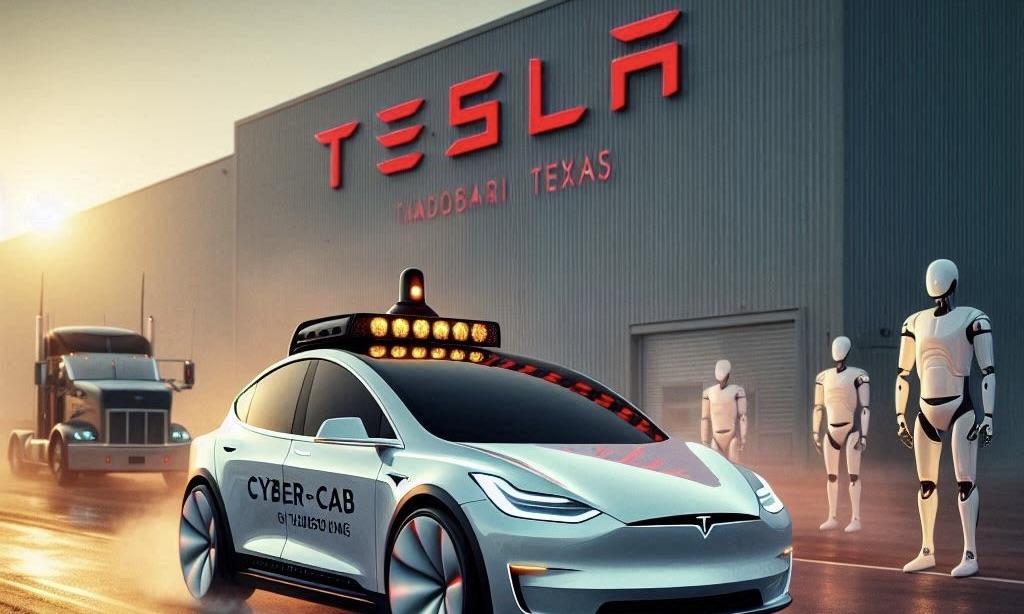
Tesla's Cybercab robotaxi has been spotted on private roads at Gigafactory Texas, marking a significant step in the company's autonomous vehicle testing. This test comes as Tesla pushes toward its goal of launching an unsupervised self-driving system by 2026. The relaxed Texas regulations make it an ideal testing ground.
Tesla Unveils Cybercab at Warner Bros. Studio Lot to Showcase Self-Driving Robotaxi Fleet
Tesla has been spotted testing its Cybercab robotaxi on the roads at Gigafactory Texas. This is notable given the limited locations where the company can test the steering-wheel-less vehicle, per Electrek.
When Tesla first unveiled the Cybercab last month, it chose to do so at the Warner Bros. studio lot, a decision made for strategic reasons. Tesla aimed to demonstrate what a self-driving robotaxi fleet could look like in an urban environment. While the studio lot mimics a small city, it consists entirely of private roads, which was crucial since Tesla has yet to seek permits for self-driving vehicle tests. Instead, the company relies on its "supervised Full Self-Driving" system, classified as a level 2 driver assist system where the driver always remains responsible for the vehicle.
This setup allows Tesla to test its system in its existing vehicles, but the Cybercab presents a different challenge, as it lacks a steering wheel and pedals altogether.
Tesla Tests Cybercab on Gigafactory Texas Roads as Company Moves Toward Unsupervised Self-Driving
Tesla has now been spotted testing the Cybercab on private roads at Gigafactory Texas in Austin. While some of the streets on the Gigafactory campus are private, Texas has more relaxed autonomous driving regulations than California, where Tesla initially unveiled the vehicle. In Texas, permits are not required for autonomous cars, making it an ideal location for testing Tesla's Cybercab.
Tesla has long avoided testing its self-driving technology in California due to the state's stringent data reporting rules for autonomous vehicles. During Tesla’s last earnings call, CEO Elon Musk and head of self-driving, Ashok Elluswamy, shared that the company aims for its Supervised FSD system to reach over 600,000 miles between disengagement by Q2 2025. At that point, Tesla plans to roll out its unsupervised self-driving system, which will precede the debut of Cybercab in the 2026 market.
While this is Tesla's ambitious goal, current data suggests the company is achieving approximately 190 miles between critical disengagements.







