


 With Iran and the US signing a peace deal, where does that leave Benjamin Netanyahu?
  Morgan Stanley Sees Chinese Auto Market Recovery Gaining Momentum in Late Summer
  AI Memory Boom Sparks Global Chip Supply Crunch
  China’s AI Manufacturing Boom Masks Weak Consumer Economy, Citi Says
  J.P. Morgan Sees Potential Vestas Guidance Upgrade Amid Strong Wind Energy Demand
  How AI prompting turned writerly description into an everyday skill
  Gold's 365-Day EMA Streak Since Oct 2023 Faces Its First Real Test at $3,980 — Break or Bounce to $4,140?
  Today’s space race could turn fatal if we don’t agree on new rules
  Goldman Sachs: US Dollar Likely to Stay Strong Despite Oil Price Retreat
  How Donald Trump has changed the way diplomacy is done


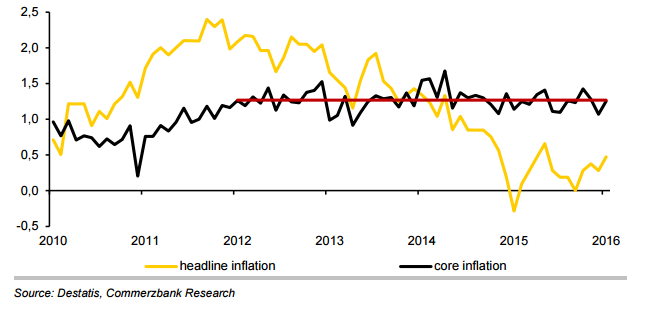
Preliminary state data released on Thursday indicated that German inflation inched up in January, but overall price pressure remained weak, which may embolden proponents of further central bank stimulus. The German inflation rate rose to 0.5% in January, as expected. However, while the headline inflation is doing flips and twists due to the volatile energy prices, the core inflation rate (without food and energy) has remained at around 1.3% since 2012. The reading was the strongest since May 2015 but still far from the ECB's target.
Volatility in energy prices is causing a rather erratic movement in the headline inflation, but core inflation rate is looking as solid as a rock, hovering around 1.3% since 2012. Nothing has been able to really push the core rate higher, figures highlight the European Central Bank's struggle in hitting its inflation target of just under 2 per cent. The ECB ultra-loose monetary policy has largely fallen flat without having much effect on the real economy.
German consumer prices account for almost 30% of the euro zone index. With the continued slump in energy prices, further second-round effects on other goods and only little pricing power from retailers and producers, a strong acceleration of German inflation any time soon is far from real. From the ECB's perspective, the steadfast anchor of the German core inflation rate constitutes a bar that is preventing the euro zone inflation rate from rising towards the 2% target.
"We do not believe that the euro zone inflation rate will move very quickly towards the ECB inflation target. Besides still not anchored inflation expectations, the slack economy and barely rising credit demand, this should lure the central bankers into further loosening monetary policy possibly in March, possibly by lowering the deposit rate by a further 10 basis points", says Commerzbank in a research report.
Fundamental deflationary pressures persisting elsewhere in the euro zone and worryingly low inflation expectations give the ECB every reason to provide more policy support. ECB President Mario Draghi has said the bank still has plenty of options left, suggesting it could act as early as March. A majority of economists in a Reuters poll said the ECB is likely to cut its deposit rate again in March.
"For the ECB ... the challenge has not become any easier. In fact, German inflation data are welcome arguments for the opponents of additional ECB action," ING Bank analyst Carsten Brzeski said.
Eurostat's flash estimate released today showed Eurozone headline inflation recovered to 0.4% y/y in January, up from 0.2% in December. The more important core inflation increased to 1.0% y/y from 0.9% previously. The ECB will have February monetary developments and inflation data to assess whether low oil prices are making their way into core inflation. For now we feel the ECB is likely to cut its deposit rate again in March. EUR/USD was little changed after Eurozone CPI data, trading at 1.0915 as of 1030 GMT.

- News

- Economy

- Central Banks
- Investing
- Research
- Roundups
- Digital Currency
- Insights
- Technical Analysis
- Technology
- Business
- Law
- Health
- Nature
- Fintech
- Science
- Topic
- Opinions
- ©Econometrics LLC . All Rights Reserved.
Subdued German core inflation to push ECB into further loosening monetary policy, possibly in March
Friday, January 29, 2016 12:08 PM UTC
Editor's Picks



- Market Data
Most Popular




