


 State of emergency in Crimea as Ukraine focuses pressure on ‘jewel in Putin’s crown’
  Smartphones are helping filmmakers tell the stories the movie industry overlooks
  USA at 250: the Black American struggle for life, liberty and the pursuit of happiness
  Goldman AM Sees Strong Buyout Opportunities in Japan, South Korea and Australia
  Gold Pulls Back After Hitting $4,180 as Geopolitical Risk Sends Crude Higher
  JPMorgan Cuts Gold Price Forecast, Sees Bullion Reaching $4,500 by End of 2026
  Goldman Sachs Says China Competition Weighs More on EU Growth Than Trade Deficit
  Alcohol is one of the most dangerous drugs, yet its presence is ubiquitous in social settings and celebrations
  Citi Raises TSMC Price Target as AI Chip Demand Strengthens Growth Outlook


We are looking ahead to modest employment creation of 4,000 jobs against 37,700 in March as the ABS (Australian Bureau of Statistics) will announce April's labour market data on 7th May. The unemployment rate likely goes up to 6.2% from 6.1% in MoM while the participation rate likely remained unchanged at 64.8%. Consumer and business confidence remain subdued.
We anticipate the employment market to remain soft in the near months as businesses look quite reluctant to invest amid the central bank uncertainty about borrowers' response to low interest rates.
The central bank cited falling business capex and resulting weak domestic demand as concerns at its April monetary policy meeting. We expect the unemployment rate to remain high in the medium term.
Technicals and Derivatives watch:
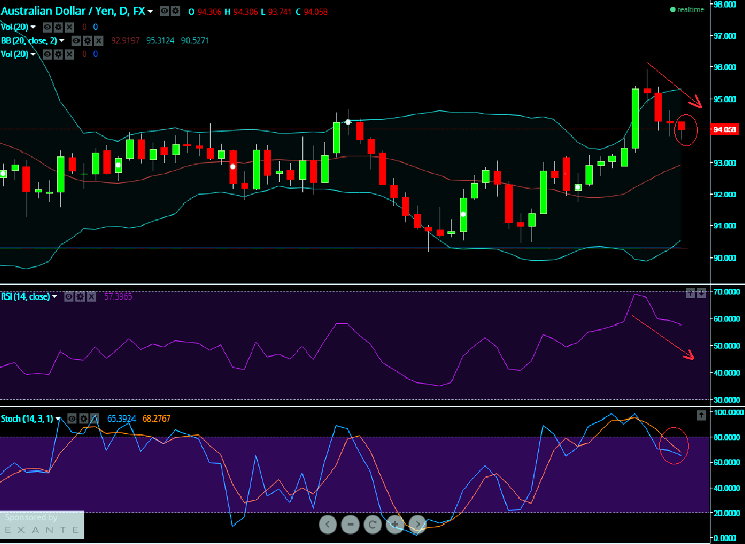
We figure out hanging man candle pattern formed on daily chart of AUDJPY pair with RSI (14) showing downward convergence to the price curve which is a strong confirmation of downswings. We don't see any near strong support until rally tests 93.463 levels to bounce back and show strength again.
As we are sensing bearish trend on the rallies of AUDJPY currency pair, thus one could get benefited from downswings in near future by taking shorts on futures of this pair.
Hedgers should try to avoid exposure to adverse price movements in the underlying currency whereas Speculators has to take position in the market betting on the price movements on either side.
Hedges or arbitrageurs become speculators if risk limits are not defined.

- News

- Economy

- Central Banks
- Investing
- Research
- Roundups
- Digital Currency
- Insights
- Technical Analysis
- Technology
- Business
- Law
- Health
- Nature
- Fintech
- Science
- Topic
- Opinions
- ©Econometrics LLC . All Rights Reserved.
Sluggish AU unemployment, consumer confidence data disappoints streets
Monday, May 4, 2015 7:58 AM UTC
Editor's Picks



- Market Data
Most Popular




