


 AI is supercharging money scams – here’s what you can do to protect yourself
  Europe can’t achieve space sovereignty alone. Here’s why
  China’s robots can run faster than Usain Bolt – now they are being prepared for war
  Big AI wants to slow down AI research. Is it a safety pause or a strategic retreat?
  Bitcoin Surges Past $85,000 Amidst Rising Risk Appetite
  Gold Slides to $4,262 as Hawkish Fed Rate Hike Triggers Technical Breakdown
  Synthetic data could ease people’s concerns about privacy breaches. But who gets to create it?


 Add as a preferred source on Google
With an OTC transaction totaling around $25. 7 million, SharpLink Gaming recently acquired 10,000 ETH from the Ethereum Foundation, thus making the first direct purchase of this magnitude by a publicly traded corporation. SharpLink Gaming wants to stake and restake this ETH, therefore withdrawing it from circulation and strengthening their dedication to the Ethereum ecosystem as they switch to an Ethereum treasury business. SharpLink's ambitious ETH accumulation since early June 2025 includes this purchase, which brings their total holdings to around 270,000 ETH at an average price of $2,667, rivaling big corporate crypto treasuries. This trend—driven by spot ETH ETFs and developments in scalability solutions—matches growing institutional interest in Ethereum. While SharpLink's strategy indicates great long-run confidence in Ethereum's future, the Ethereum Foundation intends to use the funds for protocol development and ecosystem expansion.
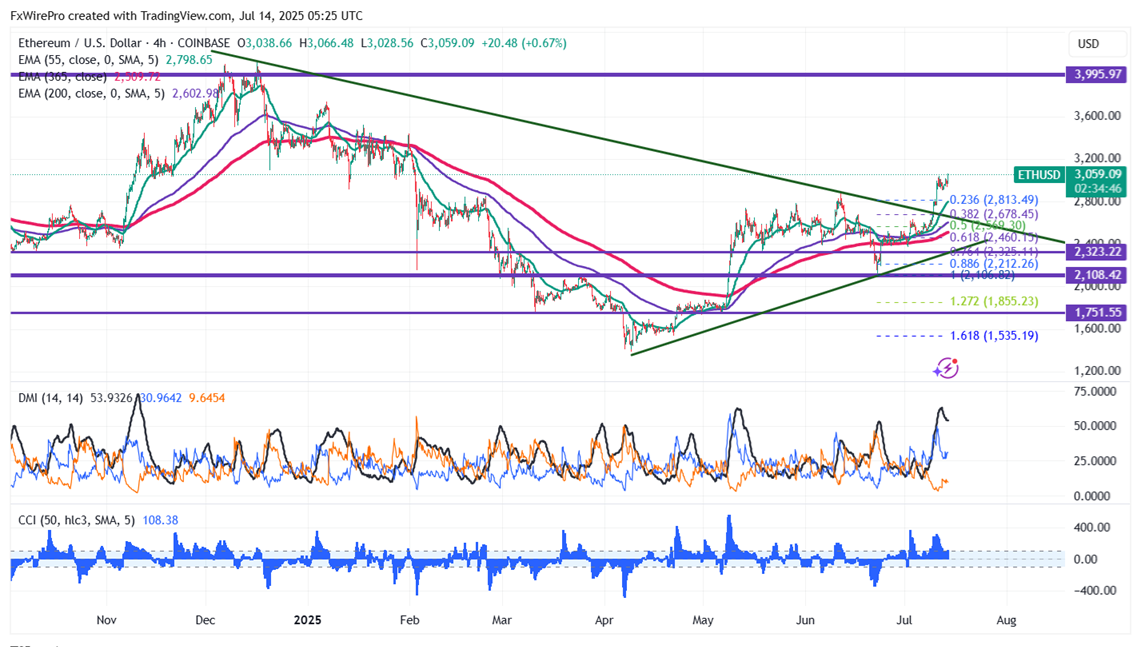
ETHUSD holds above $3000 as Bitcoin hits fresh all-time high. It hits an intraday high of $3060 and is currently trading around $3049.21.
Overall trend remains bullish as long as support $2000 remains intact. Watch out for $3020, any break above targets $3400/$3600/$3800/$4000. A robust bullish trend will only materialize above $4100.
Immediate support is around $2880. Any violation below will drag the price down to $2770/$2650/$2534/$2435/$2374/$2000/$1750/$1675/$1620/$1500/$1200/$1000. A breach below $1000 could see Ethereum plummet to $800/$500.
It is good to buy on dips around $2880 with SL around $2675 for a TP of $3000/$4000.







