


 IMF Maintains 2027 Global Growth Forecast at 3.4% Amid Rising Risks
  Oil Prices Rise as Houthi Attacks Threaten Middle East Supply
  Ripple-Backed Evernorth Set for Nasdaq Debut With 473 Million XRP
  Bank of America Predicts Yen Rebound as USD/JPY Faces Risks
  Gold Prices Rise Above $4,200 as Russia-Ukraine Energy Truce Eases Oil Concerns
  Fed Minutes Signal Another Rate Hike by Year-End
  Oil Prices Fall as Trump Ceasefire Claim Shifts Market Focus to U.S. CPI
  Philippines Current Account Deficit Seen at $19.1 Billion in 2026
  Yen in Focus as BOJ, Fed Rate Hikes Reshape Currency Markets
  Gold Prices Hit One-Week High as Oil Falls, Fed Rate Outlook Weighed
  Hong Kong’s Second Solana ETF Launches With Lower Fees
  Zcash Price Analysis: Can ZEC Rebound Above $1,300?
  Most Americans Oppose Election Betting on Prediction Markets, Poll Finds
  Hyperliquid (HYPE) Price Analysis: Can Bulls Push Above $88?
  BNB Price Faces Pressure as DOJ Investigates Binance
  Trump Demands Powell Resign Over Fed Renovation Cost Overruns


 Add as a preferred source on Google
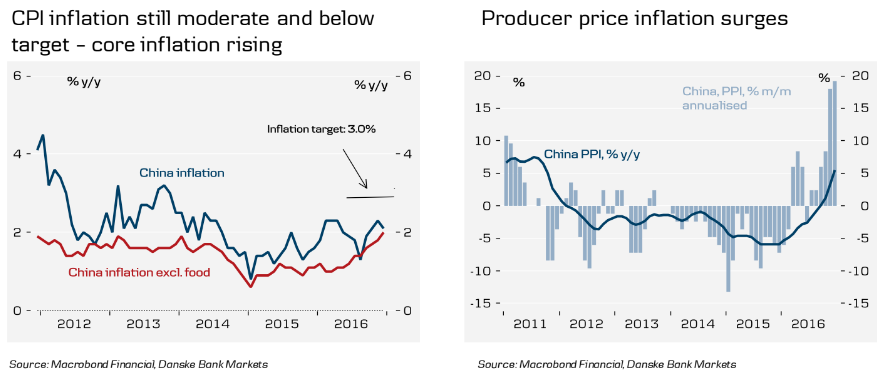
China Statistics Bureau report on January 10th showed China’s headline CPI inflation came in at 2.1 percent y/y in December, missing market expectations of 2.3 percent and below 2.3 percent recorded in November. On a monthly basis, CPI inflation rose 0.2 percent, up from 0.1 percent in the previous month.
However, China's producer prices rose for the fourth consecutive month in December to hit a 5-year high. China's producer prices rose in December at their fastest pace since September 2011 on strong raw material prices, signalling stabilization in the world's second largest economy. The producer price index gained 5.5 percent y/y compared with a 3.3 percent increase in November. The index increased 1.6 percent m/m in December, compared to 1.5 percent in November.
Rise in PPI inflation was fully in line with rise in commodity prices. Sharp rise in metal prices were observed over the past year, which accelerated post-Trump. Analysts expect PPI inflation to moderate again in 2017 as metal prices likely flatten out. That said, rise in PPI inflation is very supportive for profits. Higher producer prices improve profitability and thereby alleviate some of the liquidity pressure of corporates. That said, PPI inflation should moderate again in 2017 if metal prices flatten out.
Data suggests that "deflation is over", a trend analysts say could lead to less aggressive monetary policy. China normally hikes when CPI inflation rises which is not the case currently. Policy rates are likely to stay unchanged in the next 12-month horizon. The People's Bank of China (PBOC) is likely to hold a neutral position in its monetary policy as it pushes for structural reforms, such as tackling leverage in the property sector.
"The bottom line is that as long as the Chinese government is able to prevent deflation, (they can) buy time in order to fix some of the structural problems such as overcapacity, the economic outlook of China is not entirely pessimistic," said ANZ's chief economist for Greater China, Raymond Yeung.
Meanwhile, Shanghai Composite (SSEC) fell 0.30 percent to 3,161.67 and Shenzhen Composite (SZSE) Index slipped 0.25 percent to 10,306.34 by 07:15 GMT. FxWirePro's Hourly Yuan Strength Index remained neutral at 16.14 (a reading above +75 indicates a bullish trend, while that below -75 a bearish trend). For more details, visit http://www.fxwirepro.com/currencyindex







