


 Vietnam’s population hit the 100 million milestone. Where’s it headed?
  Gold Surges Past $4150 on Dovish Fed Signals and Weak Jobs Data; Bullish Outlook Prevails
  State of emergency in Crimea as Ukraine focuses pressure on ‘jewel in Putin’s crown’
  Elon Musk is remaking the world, like Henry Ford before him – but more dangerously
  Goldman AM Sees Strong Buyout Opportunities in Japan, South Korea and Australia
  Gold Pulls Back After Hitting $4,180 as Geopolitical Risk Sends Crude Higher
  Goldman Sachs Says China Competition Weighs More on EU Growth Than Trade Deficit
  Bernstein Names IAG, Ryanair as Top European Airline Stocks Ahead of Earnings


Well indeed with German bunds, What if the other way round.
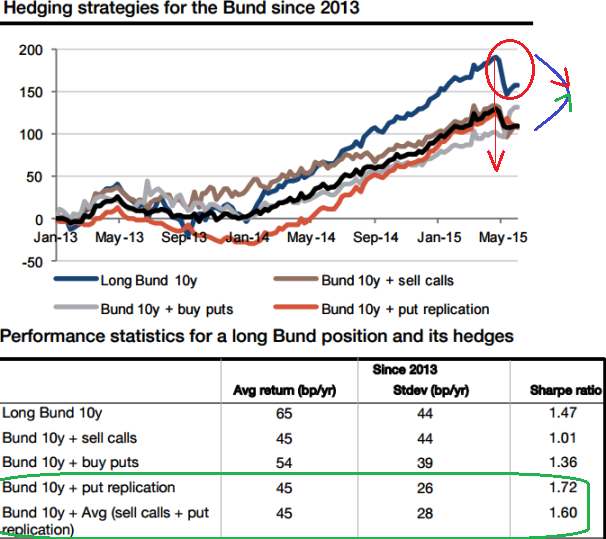
Let's visualize a scenario where German bunds did not fetch this much yields and curve would have been narrowed. In which case the fund manager who would be operating his portfolios with systematic hedging strategies would have been paid more than half of the gain in return for a reduction in volatility of just one third including costs.
We've furnished different curves representing systematic hedging strategies and their performances in the above nutshell, this provides key performance statistics.
You can cautiously observe blue curve that represents 10y treasury declining from May has been a room for put replication & short call alternatives.
In terms of risk-adjusted performance, the Sharpe ratio of a long position in German Treasuries was 1.47, and the best that we could achieve with a systematic strategy was put replication at 1.72 while standard deviation of this avenue was the least 26. While SD was 28 on option combinations which would mean risk is higher with proportionate higher returns (see grey curve).
We tend to interpret these numbers are healthy because generally the greater the value of the Sharpe ratio, the more attractive the risk-adjusted return.

- News

- Economy

- Central Banks
- Investing
- Research
- Roundups
- Digital Currency
- Insights
- Technical Analysis
- Technology
- Business
- Law
- Health
- Nature
- Fintech
- Science
- Topic
- Opinions
- ©Econometrics LLC . All Rights Reserved.
Put replication proved more effective means of hedging
Wednesday, June 10, 2015 7:21 AM UTC
Editor's Picks



- Market Data
Most Popular




