


 Goldman Sachs Flags 3 Key Risks Ahead of Europe’s Earnings Season
  JPMorgan Cuts Gold Price Forecast, Sees Bullion Reaching $4,500 by End of 2026
  Goldman Sachs Raises USD/JPY Forecast, Sees Yen Weakness Persist Through 2027
  USA at 250: the Black American struggle for life, liberty and the pursuit of happiness
  Alcohol is one of the most dangerous drugs, yet its presence is ubiquitous in social settings and celebrations
  Smartphones are helping filmmakers tell the stories the movie industry overlooks
  Vietnam’s population hit the 100 million milestone. Where’s it headed?
  State of emergency in Crimea as Ukraine focuses pressure on ‘jewel in Putin’s crown’
  Bernstein Names IAG, Ryanair as Top European Airline Stocks Ahead of Earnings
  In a rebuke to Trump, the Supreme Court rules that birthright citizenship is the law of the land


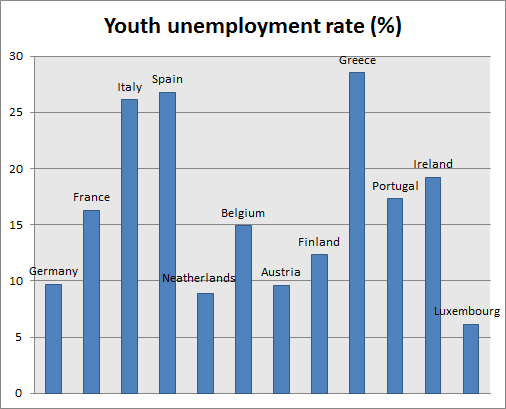
Latest statistics from Organization of Economic Development and Cooperation (OECD) show the high rates of inactivity among youth in the Euro zone.
- Since the 2008 great recession and 2011 Euro zone debt crisis the leaders have taken the path of austerity in some cases to level of draconian one.
- It could be argued that it was necessary for the return of confidence in Euro zone debt but it has cost the general public especially the youth too much.
- This year marks the seventh anniversary of 2008 crisis and it still refuses to be over. This could mark as a lost decade for the Euro zone's youth.
- Unemployment is at staggering high in most of the countries especially among youth. Greece leads with 28 percent whereas Luxemburg has the lowest at 6 percent. Even the second largest economy France has above 15 percent. The numbers exclude those doing studies or course or training.
- Until the situation over employment improves across Euro zone it is difficult to go long on Euro over longer term.
|
Youth unemployment (%) |
|
|
Germany |
9.7 |
|
France |
16.3 |
|
Italy |
26.1 |
|
Spain |
26.8 |
|
Netherlands |
8.9 |
|
Belgium |
14.9 |
|
Austria |
9.6 |
|
Finland |
12.3 |
|
Greece |
28.5 |
|
Portugal |
17.3 |
|
Ireland |
19.2 |
|
Luxembourg |
6.1 |







