


 JPMorgan Cuts Gold Price Forecast, Sees Bullion Reaching $4,500 by End of 2026
  In a rebuke to Trump, the Supreme Court rules that birthright citizenship is the law of the land
  Trump has made more than $1 billion from crypto in a year. How?
  Bernstein Names IAG, Ryanair as Top European Airline Stocks Ahead of Earnings
  Vietnam’s population hit the 100 million milestone. Where’s it headed?
  Goldman Sachs Says China Competition Weighs More on EU Growth Than Trade Deficit
  Gold Pulls Back After Hitting $4,180 as Geopolitical Risk Sends Crude Higher
  State of emergency in Crimea as Ukraine focuses pressure on ‘jewel in Putin’s crown’
  AI can be a personal trainer in your pocket – but is it safe?
  USA at 250: the Black American struggle for life, liberty and the pursuit of happiness
  Bank of America Upgrades T-Mobile to Buy, Says LEO Satellite Fears Are Overdone


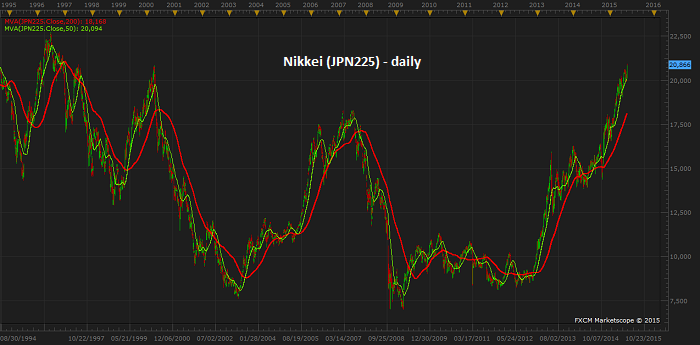
Japanese benchmark stock index has cleared 18 year high today, as weaker Yen and optimism over Greece provided the necessary support.
Japanese quantitative and qualitative easing (QQE) turns out to be massive success when considering asset price inflation, like boosting the share prices.
As Bank of Japan (BOJ) keeps its printing machine active investors remain heavily bullish on Nikkei, only second to European bourses this year. Nikkei is currently trading at 20866, just shy of 21000 mark. Some profit booking might be seen at this level.
However, BOJ's QQE is not such a success, when considering impact on real economy.
While estimate shows, Japan is growing at 3.9% annualized rate in first quarter, small businesses are not doing so well.
While large manufacturing and export houses in Japan, can benefit from weaker Yen, small businesses cater more to domestic economy which as of now is not in as good shape as it should be to benefit this sector.
Small business confidence dropped to 46.9, much worse than economists' median estimate of 48.3 and 48.1 prior. The mark below 50 indicates contraction. Last time confidence was above 50 was back in March 2014.







