


 Yen Near 40-Year Low as USD/JPY Approaches Key 162 Level, Raising Intervention Concerns
  Dollar Holds Firm as U.S.-Iran Talks Ease Tensions, GBP/USD Slips Amid UK Political Uncertainty
  Wall Street Slides as AI Stocks Tumble Following South Korea Tech Sell-Off
  Oil Prices Fall as Iran Peace Talks Progress, Hormuz Reopens, and U.S. SPR Hits 1983 Low
  U.S.-Iran Diplomacy Helps Drive Gasoline Prices Down 15% From May Highs
  Asian Stocks Slide as AI Rally Pauses, South Korean Chipmakers Lead Regional Decline
  Best Gold Stocks to Buy Now: AABB, GOLD, GDX
  Asian Stocks Slip as Oil Rebounds Amid Fed Rate Hike Fears
  France Faces Long Road to Economic Rebalancing as Weak Demand and High Rates Weigh, Says Citi
  Malaysia Central Bank Moves to Support Ringgit Amid Foreign Fund Outflows
  US Dollar Hits One-Year High as Hawkish Fed Outlook Overshadows Middle East Developments


New Zealand’s unemployment rate ticked down to 4.0 percent in the December 2019 quarter – below ANZ, market, and RBNZ expectations of 4.2 percent. This followed a downwardly-revised print of 4.1 percent in Q3. These data can be volatile on a quarter-on-quarter basis, but the underlying details point to a robust labour market and household sector.
However, the unemployment rate remains within the RBNZ’s estimate of full employment (a range of 4.0-4.4 percent), consistent with underlying inflation pressures holding close to the target mid-point and ‘maximum sustainable employment’.
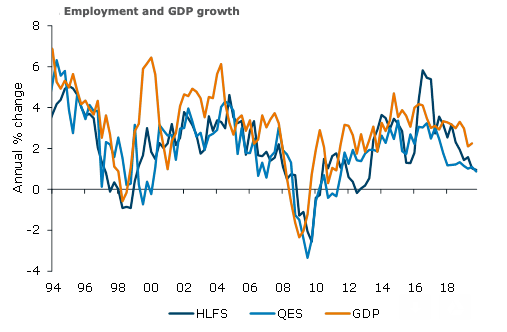
Employment growth in Q4 was weak, with HLFS employment (a survey of households) flat q/q. Annual employment growth was also flat at 1.0 percent, and continues to move within the broad range of indicators. QES employment (from a survey of businesses) was also modest. QES filled jobs rose 0.1 percent q/q, with annual growth slowing from 1.1 percent in Q3 to 0.9 percent.
But offsetting the slowing in employment growth in terms of labour market capacity pressures, growth in the working-age population continues to slow. The participation rate ticked down 0.3 percentage points to 70.1 percent, but remains at a historically high level.
In addition to employment, hours worked can provide an indication of economic activity and slack, though it can be noisy. QES hours paid (which tends to track GDP growth over history) grew 0.6 percent q/q, with annual growth lifting 0.5 percentage points to 1.6 percent.
This is consistent with our current forecast of 0.5 percent q/q (1.7 percent y/y) for Q4 GDP growth. On the other hand, HLFS hours worked (which is far more volatile) posted a 0.5 percent q/q decline, pushing annual growth from 2.3 percent to just 0.5 percent.
Public sector wage growth came in at 0.8 percent q/q, pushing annual growth from 3.0 percent in Q3 to 3.2 percent in Q4. Teacher, nurse, and police pay settlements have bumped up public sector wage growth in previous quarters.
Today’s data will be incorporated into the RBNZ’s February MPS forecasts (out next Wednesday), and are unlikely to have a material impact on their outlook, but they will certainly add to the stronger starting point compared to the November MPS, the report added.
"That said, emerging risks related to the novel coronavirus will be weighing on their thinking and assessment. Developments regarding this tragic shock are fast moving and the impacts highly uncertain. We expect the RBNZ to keep the OCR on hold at 1% next week, acknowledging these risks and emphasising their willingness to provide additional stimulus if required," ANZ Research further commented in the report.







