


 Gold Prices Fall Amid Rate Jitters; Copper Steady as China Stimulus Eyed
  Oil Prices Drop as Middle East Supply Recovery Eases Market Concerns
  South Korea’s KOSPI Jumps Over 5% as Samsung, SK Hynix Rally on Micron Earnings Boost
  Iran Attack in Strait of Hormuz Pushes Oil Prices Higher
  Bessent Says U.S. Must Strengthen Supply Chains and Economic Security
  Wall Street Ends Mixed as Tech Stocks Struggle Ahead of Micron Earnings
  Asian Stocks Sink as Apple Price Hikes Spark AI Valuation Fears, South Korea and Japan Lead Selloff
  Asian Currencies Trade Mixed as Yen Hovers Near 40-Year Low, Dollar Holds Firm on Fed Outlook
  Oil Prices Rebound as Strait of Hormuz Tensions Return After Ship Attack Near Oman
  Japan Signals Preference for Low Interest Rates as BOJ Policy Debate Intensifies


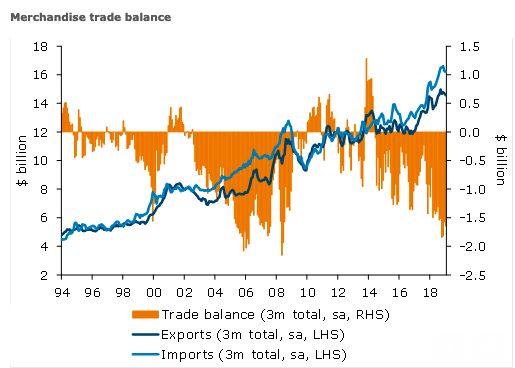
New Zealand’s trade balance for the month of January came in considerably weaker than market expectations with exports below expectations and imports considerably stronger. Exports are expected to pick up in the coming months as more meat and dairy products start to flow out of the country, according to the latest report from ANZ Research.
The unadjusted monthly trade balance turned a large deficit of $914 million in January. Exports at just $4.4 billion were below expectations with the slow start to the meat processing season primarily to blame. Imports were strong, partially due to a $200 million large item, but the overall import strength indicates domestic demand remains robust.
On a seasonally adjusted basis, exports decreased 7.8 percent m/m. Dairy volumes lifted, but the recent uptick in dairy prices is yet to be reflected in export values. Meat volumes were down 6.2 percent which combined with slightly weaker prices pulled the value of this export category down 8.8 percent. Strong prices for logs offset a sharp reduction January export volumes which were down 25.3 percent.
Seasonally adjusted imports rose 0.4 percent m/m. Petrol imports dropped by 6.1 percent following a strong lift the previous month. Textiles imports lifted 29.3 percent, more than offsetting the sharp drop in December. Imports of optical and medical goods lifted sharply, up 16.7 percent m/m in January. There was also a large item ($200 million) boosting an already robust print for monthly imports.
On a regional basis, exports to China maintained their positive trend, up 15.2 percent in the year to January. However a sharp drop in exports to Australia was recorded in January, although on an annual basis exports to this market are still slightly stronger.
"The annual deficit is expected to narrow as the year progresses reflecting stronger export volumes of meat, dairy and forestry, while the improvement in prices for dairy should start to flow through in the coming months," the report added.
Image courtesy: ANZ Research







