


 US Stock Futures Rise as Investors Eye Fed Minutes, AI Stocks, and Q2 Earnings
  Japan Defense Stocks Rally on Report of New Defense Ministry Bureau for Global Cooperation
  Oil Prices Slip as OPEC+ Boosts August Output, Oversupply Concerns Weigh on Crude Market
  Iran Begins Oil Sale Talks With Japan Under U.S. Sanctions Waiver Amid Shipping Risks
  Iran Targets U.S. Bases in Bahrain, Kuwait as Hormuz Conflict Escalates and Oil Prices Jump
  Japan Regional Bank Stocks Drop After Zentoshin Bankruptcy Sparks Credit Risk Concerns
  China 618 Smartphone Sales Drop 13% as Higher Prices Hurt Demand, Huawei Gains Market Share
  South Korea’s KOSPI Plunges as Samsung, AI Chip Stocks Trigger Market Sell-Off


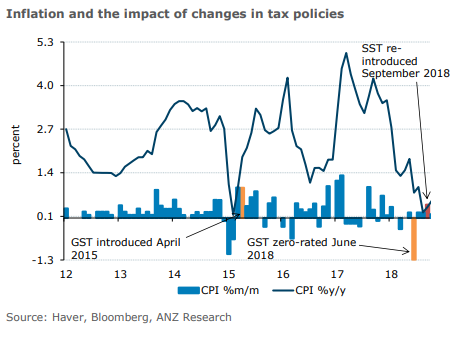
Malaysia’s underlying inflation is expected to remain low and stable through the first half of 2019. Combined with more moderate economic activity and external factors such as trade tensions, Bank Negara Malaysia (BNM) to keep the OPR unchanged at 3.25 percent for a while, according to the latest report from ANZ Research.
Headline CPI inflation crept up to 0.3 percent y/y in September from 0.2 percent y/y in August. On a sequential basis, headline inflation increased 0.4 percent m/m in September following a 0.2 percent m/m rise in August.
Although the Sales and Service Tax (SST) came into effect on September 1, its impact was muted presumably because leftover inventories and inputs were not subject to the price rise. The impact will likely be evident over the next few months as firms pass on the SST to consumers.
Government subsidies on RON95 grade fuel and diesel continue to shield Malaysian consumers from global oil prices and are largely responsible for the lower contribution of the transport component in recent months.
Meanwhile, on a sequential basis, food and beverage prices (which account for 29.5 percent of the basket) were up 0.5 percent m/m driven by an increase in fish and seafood prices, as well as the ‘food away from home’ subcomponent.







