


 Goldman Sachs Says China Competition Weighs More on EU Growth Than Trade Deficit
  Alcohol is one of the most dangerous drugs, yet its presence is ubiquitous in social settings and celebrations
  Trump has made more than $1 billion from crypto in a year. How?
  Smartphones are helping filmmakers tell the stories the movie industry overlooks
  Gold Pulls Back After Hitting $4,180 as Geopolitical Risk Sends Crude Higher
  Goldman Sachs Raises USD/JPY Forecast, Sees Yen Weakness Persist Through 2027
  State of emergency in Crimea as Ukraine focuses pressure on ‘jewel in Putin’s crown’
  In a rebuke to Trump, the Supreme Court rules that birthright citizenship is the law of the land
  JPMorgan Cuts Gold Price Forecast, Sees Bullion Reaching $4,500 by End of 2026


Federal Reserve (FED) is about to hike rates this year after almost 9 years since the last rise. Current rate is maintained close to zero percent. The most probable next hike would be to bring the Fed funds rate to range of 0.25%.
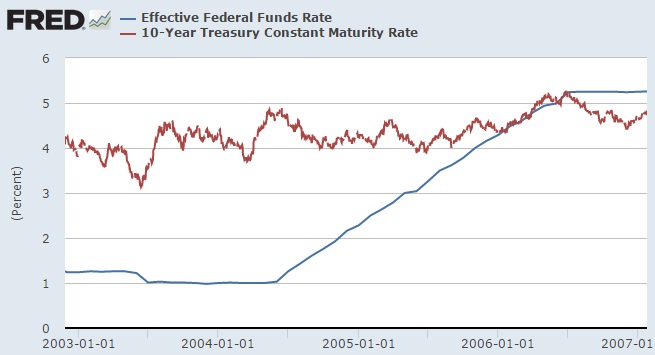
- FED raised rates in 2004 from 1% to 5.25% by 2006. During which performance of the asset class remained mixed.
- Dollar index traded within a range between 80 to 90. So FED raising rates not necessarily mean a strong dollar, but this time it could be different as the major central banks' monetary policies are diverging unlike then.
- The attached chart explains the relation of the longer end treasury namely 10 year yield with FED funds rate for the period of previous rate hike, during which the FED funds rate saw rise of 425 basis points, whereas the treasury yields moved only 50 basis points.
- This may not hold true completely this time, as the yield differential between the FED and the 10 year was much larger than the current.
- Still, it may be unwise to bet heavily against the longer end, once the FED actually begins.
- Partial curve steepening could occur at some point ahead, however more could be parallel shifts.







