


 Meta Unveils Muse Charm AI Device, Expands Smart Glasses Lineup
  Microsoft Stock Upgraded as Stifel Sees Stronger Azure Growth
  AMD Hits $1 Trillion as BofA Raises Price Target to $720
  DaVoice Sues Perplexity AI Over Trade Secrets
  Meta Found Liable in New Mexico Facebook Data Privacy Case
  SoftBank Shares Fall as Oracle Flags Stargate Data Center Delay Risk
  Oracle Shares Fall as New Mexico AI Data Center Faces Power Delays
  Meta Partners With Shopify to Bring Shop Pay Checkout to Muse AI
  Apple Extends Qualcomm Patent Licensing Deal
  BlackBerry Shares Rise as Q2 Earnings, Revenue Beat Estimates


 Add as a preferred source on Google

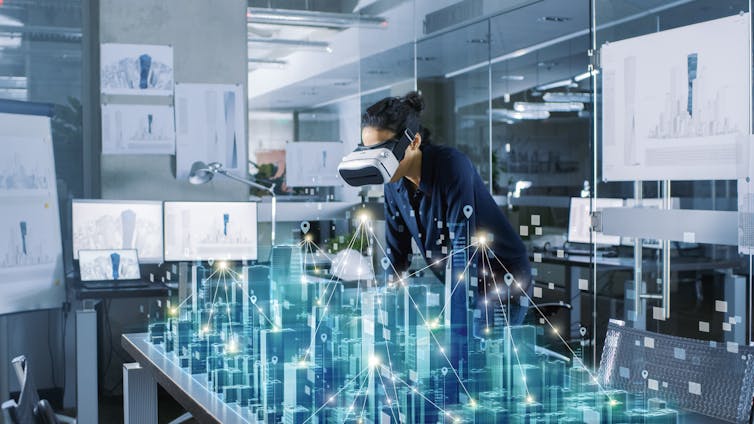
Imagine stepping into your dream home before it is even built. Virtual reality (VR) technologies are revolutionizing architecture by allowing clients to walk through their future spaces, change details and experience the space before construction. VR bridges the gap between imagination and reality.
But this transformation goes beyond esthetics. VR offers many opportunities for how architects design, refine and communicate their work, and also for architectural learning and public consultation.
Fostering better communication
VR brings clarity to architectural design. While traditional blueprints and 3D renderings can mainly convey spatial relationships, lighting conditions and material finishes, VR immerses users in a realistic simulation of the space.
For clients, this means stepping into their future home or office, feeling its proportions and even adjusting design elements like wall colours or furniture placements in real time.

Clients no longer need to rely on imagination or wait until construction begins to see the results of their decisions. (Shutterstock)
This level of engagement changes the client and architect dynamic. Clients no longer need to rely on imagination or wait until construction begins to see the results of their decisions. Instead, VR creates a collaborative environment that minimizes misunderstandings and costly post-construction modifications not only for clients but also for construction teams.
Reducing waste, promoting sustainability
The role of VR in promoting sustainability in renovation, demolition and contsruction is equally powerful. VR and AR (augmented reality) serve as a valuable tool in green transitioning by allowing design and construction teams to design and optimize buildings while minimizing waste and reducing energy consumption.
For example, architects can simulate daylight to optimize natural lighting to give clients a feel for spaces that may otherwise need to be modified upon completion. Construction teams can use augmented reality (AR) to do the same by precisely positioning elements like beams, walls and utilities. These processes optimize design and reduce waste during construction.
The result of this process is buildings that are closer to our sustainability goals without compromising on esthetics or functionality.
Student learning
One of the most important aspects of VR is its potential to create accessibility and equity in architecture. For architecture students, studying architectural precedents is an essential part of their education.
However, many of these precedents are often out of reach due to geographic, financial or logistical limitations. VR offers immersive experiences that allow students to virtually explore architectural precedents from anywhere in the world. Heritage sites that are at risk due to environmental or human factors can also be digitally preserved and experienced globally through VR.
VR can immerse students in designs. (Shutterstock)
The impact of VR isn’t confined to the design process; it’s reshaping architectural education and training. Traditionally, architectural students relied on physical models or 2D drawings to develop their skills and communicate ideas. VR now immerses students in their designs enabling them to walk through designs, assess spatial relationships and experiment with design decisions in real time.
This approach not only enhances their spatial understanding but also equips them to address real-world challenges like sustainability and user-centric design.
Public engagement
VR also offers opportunities around public engagement in architecture that could advance inclusion and equity in the design process. When everyone has the ability to experience and provide input on designs, architecture and urban planning become a collaborative endeavour that reflects diverse perspectives and needs.
In this way, VR can serve as a tool to redefine architecture, urban planning or heritage preservation as a truly collective and inclusive process.
Architects and planners can simulate cities, enabling communities to understand proposed developments and participate in decision-making processes. For example, urban renewal projects that implicate large and diverse populations can make use of virtual reality to enable users to experience and interact with the proposed environment before it is built.
The impact of VR and extended reality (XR) on architecture and construction goes beyond how buildings are designed and reshapes how people interact with and experience them. Overall, VR is a powerful tool that different stakeholders can use to design, experience and construct spaces that are more user-centric, sustainable and inclusive.







