


 Trump’s Iran Strategy: What Has Been Achieved After Three Months of Conflict?
  Mexico's Undervalued Equity Market Offers Long-Term Investment Potential
  Indonesia Surprises Markets with Interest Rate Cut Amid Currency Pressure
  Sell the Bounce": Gold Rally Stalls Near $4165 as Fed Hawks Slam the Door on Rate Cuts — Targets $4000/$3600
  Moldova Criticizes Russia Amid Transdniestria Energy Crisis
  Lithium Market Poised for Recovery Amid Supply Cuts and Rising Demand
  US Futures Rise as Investors Eye Earnings, Inflation Data, and Wildfire Impacts
  Today’s space race could turn fatal if we don’t agree on new rules
  World Cup technology: from ref cams to AI analysts, cutting-edge research is changing the game
  SpaceX Stock Gets $175 Target as Analysts See Massive Growth Ahead
  U.S. Stocks vs. Bonds: Are Diverging Valuations Signaling a Shift?
  Bank of America Posts Strong Q4 2024 Results, Shares Rise
  With Iran and the US signing a peace deal, where does that leave Benjamin Netanyahu?


The euro area corporates are in a good position to expand, the corporates in this geography have become net savers and low-interest costs, lower dividend payouts, lower CapEx explains the shift.
Corporates’ capacity to accelerate CapEx looks good.
A couple of months ago, we still expected the Euro area to grow at only a modestly above-trend pace this year. However, business and consumer sentiment have improved sharply, with the composite PMI signaling 3% growth in March. This prompted us to raise our 2017 growth forecast to 2.2% Q4.
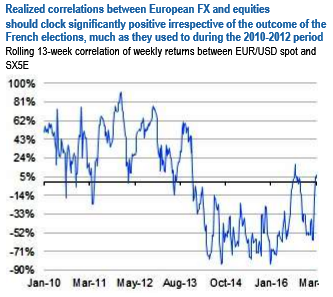
European FX vs. equity implied correlations currently trade in the 0 -20% range in 6M –1Y expiries, which might be fair relative to current realized correlations but ought to reprice higher in coming months if a concerted European asset rally reverts corrs back to average levels of the 2010-2012 period (refer above chart).
Investors have already started to take advantage of this dislocation and forced short-dated (<3M) EURUSD vs. SX5E correlations up to +25%, but there is still room for the move to play out in longer tenors.
EURUSD > 2% OTMS, SX5E > 5% OTMS: dual digitals costs 14.5% EUR indic. in 3M tenors (indiv. digis 43% and 26% respectively) and 18.5% EUR indic. in 1Y (indiv. digis 58% and 37% respectively).







