


 Indonesia Surprises Markets with Interest Rate Cut Amid Currency Pressure
  UBS Projects Mixed Market Outlook for 2025 Amid Trump Policy Uncertainty
  Urban studies: Doing research when every city is different
  Stock Futures Dip as Investors Await Key Payrolls Data
  US Gas Market Poised for Supercycle: Bernstein Analysts
  China’s Growth Faces Structural Challenges Amid Doubts Over Data
  China's Refining Industry Faces Major Shakeup Amid Challenges
  Lithium Market Poised for Recovery Amid Supply Cuts and Rising Demand
  Oil Prices Dip Slightly Amid Focus on Russian Sanctions and U.S. Inflation Data
  2025 Market Outlook: Key January Events to Watch
  Moldova Criticizes Russia Amid Transdniestria Energy Crisis
  S&P 500 Relies on Tech for Growth in Q4 2024, Says Barclays
  Fed May Resume Rate Hikes: BofA Analysts Outline Key Scenarios
  Mexico's Undervalued Equity Market Offers Long-Term Investment Potential
  Energy Sector Outlook 2025: AI's Role and Market Dynamics
  Wall Street Analysts Weigh in on Latest NFP Data


With the volatile markets, global trade turbulence, elections and geopolitics, “risk” was one of the key business words of 2018. It is completely normal that the yen eased intraday yesterday and also today. Of course, the flash crash of the exchange rates on Wednesday night would not have been possible without any fundamental justification: “risk-off” in times of increasing economic concerns.
However, episodes like the one we saw yesterday also have the tendency of overshooting. The largest share of overshooting (e.g. USDJPY below 105) was corrected right away, but after that the FX market has to shake itself down a little. What is the residual effect that is acceptable for the average FX market participant?
In the case of marginal exchange rate moves this process happens continuously, in the case of major distortions like the one seen two night ago this takes some time.
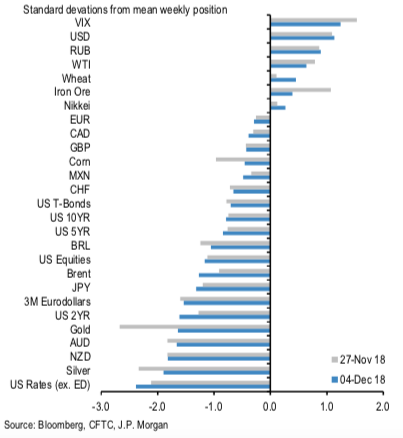
Difference between net spec positions on risky & safe currencies.
Net spec position is calculated in USD across 5 "risky" and 3 "safe" currencies (safe-haven currencies also include Gold).
These positions are then scaled by open interest and we take an average of "risky" and "safe" assets to create two series.
The chart is then simply the difference between the "risky" and "safe" series.
The final series shown in the chart below is demeaned using data since 2006.
The risky currencies are: AUD, NZD, CAD, RUB, MXN and BRL.
The safe currencies are: JPY, CHF and Gold. Courtesy: JPM
Currency Strength Index: FxWirePro's hourly EUR spot index is inching towards -31 levels (which is mildly bearish), while hourly USD spot index was at 37 (mildly bullish), while articulating (at 12:16 GMT).
For more details on the index, please refer below weblink: http://www.fxwirepro.com/currencyindex







